Sideways Market Investing: The Real Test of Long-Term Investors
Introduction
Six months pass.
Then another six.
You log in to your brokerage account expecting something exciting. Instead, your portfolio looks almost identical to what it did a year ago. Meanwhile, social media is flooded with screenshots of “multibaggers,” “breakout stocks,” and traders celebrating double-digit gains in a matter of weeks.
Suddenly, the company you were once proud to own starts feeling like a mistake.
Nothing is actually wrong with the business. Revenue is growing. Earnings are improving. Management continues to execute well. Yet the share price refuses to cooperate.
The only thing that has changed is your patience.
This is the reality of sideways market investing. When stock prices move sideways for months or even years, the greatest challenge isn’t analyzing businesses—it’s managing your own psychology.
It quietly tests something that neither a bull market nor a bear market can—your conviction.
Bull markets make everyone look intelligent. Bear markets expose risk management. But sideways markets reveal character.
Everyone talks about surviving market crashes. Everyone celebrates spectacular rallies. Very few prepare you for the long, uneventful periods in between, where prices refuse to move and every day feels exactly like the one before.
A rising stock is easy to own because optimism is contagious. A crashing stock presents an obvious decision—you either buy more, hold your conviction, or admit you were wrong. But a stock that goes nowhere for months or even years creates a completely different challenge.
It doesn’t attack your portfolio.
It attacks your patience.
Ironically, many of history’s greatest wealth creators spent long periods doing very little before delivering extraordinary returns. During those quiet years, impatient investors walked away while patient business owners quietly stayed the course.
Perhaps we’ve been asking the wrong question all along.
Instead of asking, “Why isn’t my stock moving?”, maybe we should ask, “Is the business still progressing?”
This philosophy closely aligns with Warren Buffett’s long-standing view that investors should think like business owners rather than stock traders, a theme he has repeated in his shareholder letters over several decades.
Sideways Market Investing Is a Test of Conviction
There is a famous saying that the stock market transfers money from the impatient to the patient. While that sounds inspiring, it misses an important truth.
The market doesn’t reward patience immediately.
It first tests whether you genuinely possess it.
That test rarely happens during a roaring bull market, when almost every investment appears to be working. Nor does it usually happen during a sharp market crash, when fear dominates every headline.
The toughest examination arrives when absolutely nothing seems to happen.
Your company keeps reporting decent quarterly results. Annual reports remain encouraging. Management continues to invest for the future. Yet the share price remains trapped within the same narrow range month after month.
This is precisely where many investors unknowingly fail.
Not because they lose money.
Because they lose conviction.
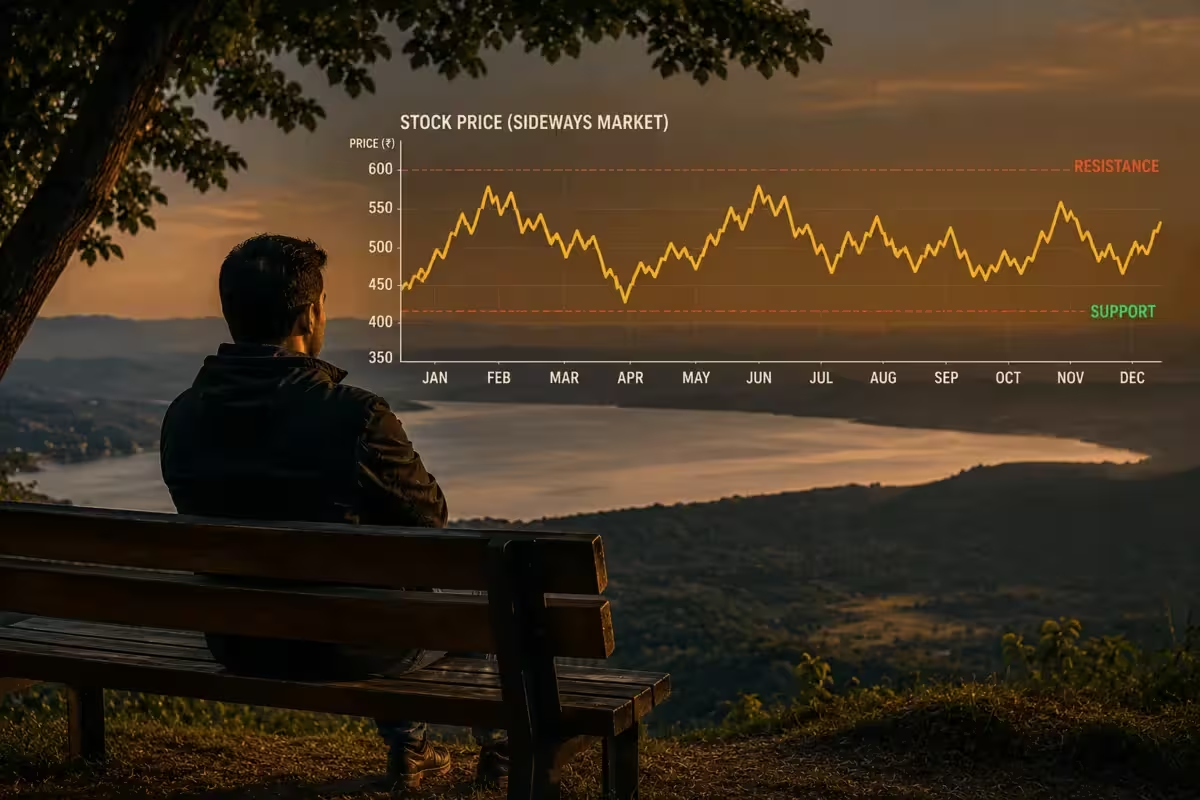
Most investors proudly describe themselves as long-term investors when they buy a stock. But the market has a remarkable way of separating intention from reality.
After six months of inactivity, they become restless.
After one year, they begin questioning their research.
After two years, they convince themselves that there must be a better opportunity elsewhere.
Eventually, they sell—not because the business disappointed them, but because the stock price did.
Ironically, many of those sales occur just before the market finally begins recognising the business’s true value.
The market doesn’t pay you for being busy. It pays you for being right—and waiting long enough.
That is the hidden purpose of a sideways market. It isn’t merely marking time. It is quietly filtering investors based on temperament rather than intelligence.
The Market Doesn’t Owe You Constant Excitement
Human beings are wired to seek progress. We enjoy movement because movement feels like success. That’s why bull markets are emotionally satisfying—they constantly reassure us that we were right.
Sideways markets offer no such reassurance.
Instead, they create silence. And silence makes investors uncomfortable.
When your portfolio hardly changes for months, your mind begins searching for explanations. Before long, perfectly rational investors start asking themselves questions like:
- “Should I switch to another stock?”
- “Has this company lost its future?”
- “Everyone else seems to be making money. Why am I stuck?”
- “Did I make a mistake buying this business?“
- “Would I have been better off chasing the latest trend?”
Notice something interesting.
None of these questions begin with the business.
Every one of them begins with the share price.
Successful sideways market investing requires investors to separate business performance from short-term stock price movements. That distinction is easy to understand but remarkably difficult to practise.
That is exactly where many investors unknowingly drift away from investing and move towards speculation.
Fear of Missing Out (FOMO) slowly takes control. Watching others chase momentum creates the illusion that constant activity is the same as making progress. Investors begin buying and selling—not because new facts have emerged, but simply because inactivity feels uncomfortable.
The market understands this better than we do.
It knows that boredom is often a more effective way of separating investors from their money than panic.
A bear market frightens investors into selling.
A sideways market bores them into selling.
A bull market tests your optimism. A bear market tests your courage. A sideways market tests your conviction.
And that conviction should never come from a moving stock price. It should come from your understanding of the business you own.
Sideways Markets Are Psychological Exams
Let’s imagine two investors.
Investor A and Investor B both buy shares of the same high-quality company. They do their homework, read the annual reports, understand the business model, and invest at roughly the same price.
For the next three years, something unusual happens.
The business keeps improving.
The share price doesn’t.
Every quarterly result shows steady progress. Revenue grows. Profits improve. Cash flow strengthens. Debt declines. The company expands into new markets.
Yet the stock remains trapped in a narrow trading range.
After twelve frustrating months, Investor A starts looking elsewhere.
He watches friends make quick gains in fashionable sectors. Financial television constantly discusses the next breakout stock. Analysts publish ever-changing price targets. Social media celebrates every new all-time high.
Eventually, Investor A convinces himself that staying invested is the real mistake.
He sells.
Investor B doesn’t.
Not because he is stubborn.
Because nothing meaningful has changed in the business.
| What Happens? | Investor A (The Impatient Investor) | Investor B (The Business Owner) |
|---|---|---|
| Focus | Daily stock price | Business performance |
| Reaction to sideways market | Looks for excitement elsewhere | Reviews whether the investment thesis still holds |
| Decision | Sells a good business | Continues owning it |
| Five years later | Still searching for the next winner | Benefits from years of uninterrupted compounding |
The difference between them isn’t intelligence.
It’s temperament.
Activity rarely compounds.
Ownership does.
The stock market has never rewarded investors simply for being active. It rewards those who identify outstanding businesses and then allow time to work on their behalf.
The Hardest Part of Investing Is Looking Wrong
Most people believe the hardest part of investing is watching their portfolio fall during a bear market.
It isn’t.
The hardest part is looking wrong while you’re actually right.
Imagine recommending a company to a close friend.
Six months later, the stock hasn’t moved.
Your friend jokes that your “great investment” has gone nowhere.
Another acquaintance buys a trendy stock and makes 40% in a few months.
Suddenly, you begin doubting yourself.
Not because your company has deteriorated.
Because someone else appears to be winning.
This is one of the most dangerous psychological traps in investing.
We compare our long-term journey with someone else’s short-term result.
Markets encourage this behaviour because prices are visible every second, while business value compounds quietly in the background.
A company doesn’t become more valuable because its share price rises today.
Its share price rises because, sooner or later, the market recognises the value the business has already created.
Markets measure popularity in the short run.
Businesses create wealth in the long run.
Understanding this distinction changes everything.
The Market Rewards Business Growth, Not Daily Price Movements
Every listed company has two stories unfolding at the same time.
The first story is visible every second.
It is the stock price.
The second story unfolds much more slowly.
It is the business itself.
Unfortunately, investors spend most of their time watching the first story and very little time understanding the second.
Share prices move because of countless short-term factors:
- Market sentiment
- Liquidity
- Macroeconomic news
- Interest rates
- Foreign institutional flows
- Political events
- Temporary optimism or fear
A business, however, grows through a completely different set of drivers.
- Consistent revenue growth
- Higher profitability
- Improving return on capital
- Growing free cash flow
- Competitive advantages
- Intelligent capital allocation
- Visionary management execution
These two timelines rarely move together.
Sometimes the stock runs far ahead of the business.
Sometimes the business quietly outruns the stock.
The second situation frustrates impatient investors.
It creates extraordinary opportunities for patient ones.
The Accumulation Phase That Most Investors Misunderstand
A sideways market often feels like wasted time.
In reality, it is frequently an accumulation phase.
While the stock appears dormant, the company may be laying the foundation for its next decade of growth.
Consider Reliance Industries.
For years after the global financial crisis, many investors felt the stock had lost its momentum. The share price delivered little excitement for an extended period, leading some shareholders to look elsewhere.
Yet beneath the surface, the company was making some of the most significant investments in its history.
Reliance’s annual reports during those years document the scale of these long-term investments and strategic priorities.
It was building Jio.
It was expanding its retail business.
It was preparing for a transformation that would eventually reshape not only the company but also entire industries.
The business improved long before the share price reflected that progress.
Investors who judged the company solely by its stock chart became impatient.
Investors who judged the business itself were eventually rewarded.
That is why serious investors should spend less time asking whether the stock is moving and more time asking whether the business is becoming stronger than it was a year ago.
Impatience rarely announces itself with a dramatic mistake.
Instead, it quietly disguises itself as action.
You tell yourself you’re “reallocating capital.” You convince yourself you’re “finding better opportunities.” Sometimes those reasons are valid. More often, they’re simply elegant ways of saying, “I’m tired of waiting.”
Every unnecessary sale has a cost. Some costs are visible. Others remain hidden for years.
- Brokerage charges and statutory taxes.
- Capital gains tax that could have been deferred.
- Slippage between the selling and buying prices.
- The emotional stress of trying to time the next investment.
- The opportunity cost of selling a business just before the market recognises its value.
However, the biggest cost is one that rarely appears on your brokerage statement.
You interrupt the compounding process.
Compounding is like planting a tree. Every time you uproot it because another tree appears to be growing faster, you reset the process. The new tree may eventually flourish—but you’ve sacrificed years of uninterrupted growth in the process.
Compounding doesn’t reward the investor who moves the fastest.
It rewards the one who interrupts it the least.
This is why some of the greatest investors in history have often described inactivity as one of their biggest advantages. They weren’t inactive because they lacked ideas. They were inactive because they had already found outstanding businesses worth owning.
The Comparison Trap
Nothing destroys patience faster than comparison.
Today, comparison has become easier than ever.
Open any social media platform and you’ll find someone celebrating a stock that has doubled in six months. Open a financial news channel and someone is predicting the next market leader. Browse online forums and you’ll discover investors claiming extraordinary returns with astonishing confidence.
What you rarely see are the years of silence.
You don’t see the five years someone patiently held a business before it finally delivered exceptional returns. You don’t see the disciplined investor who ignored fashionable trends because his investment thesis remained intact.
Social media highlights exciting outcomes. It almost never highlights patient processes.
The result is predictable.
Investors begin comparing their carefully researched portfolio with someone else’s best trade.
That comparison is neither fair nor useful.
Successful investing isn’t about beating everyone else every month.
It’s about consistently making decisions that improve your own financial future over many years.
The stock market is not a competition against other investors.
It is a continuous battle against your own emotions.
Ask Better Questions
When markets remain flat for an extended period, most investors ask the wrong question.
“Why isn’t my stock moving?”
That question focuses entirely on something you cannot control.
A better question is:
“Has anything fundamentally changed in the business?”
Instead of staring at the price chart, spend that time reviewing the company’s progress.
- Is revenue continuing to grow?
- Are profits becoming more consistent?
- Is free cash flow improving?
- Has return on capital increased?
- Is management allocating capital intelligently?
- Has debt reduced or remained manageable?
- Is the company strengthening its competitive advantage?
- Would I still be happy to buy this business at today’s valuation?
If the answers remain positive, perhaps nothing is wrong with your investment.
Perhaps the market is simply taking longer than you expected.
Markets don’t operate according to our personal deadlines.
Eventually, however, sustained business performance has a remarkable habit of finding its way into the stock price.
What Should You Actually Do During a Sideways Market?
The answer may surprise you.
Probably less than you think.
Doing nothing doesn’t mean ignoring your investments. It means avoiding unnecessary action while continuing to monitor the business.
A productive sideways market is an opportunity to become a better investor rather than a busier one.
- Read the company’s quarterly results instead of watching the daily chart.
- Study the annual report to understand management’s long-term strategy.
- Listen to earnings conference calls whenever possible.
- Reinvest dividends if appropriate for your financial goals.
- Continue your SIP or periodic investments if valuations remain attractive.
- Review your original investment thesis instead of reacting to short-term sentiment.
- Keep a watchlist of quality businesses rather than chasing momentum stocks.
- Spend more time learning about businesses and less time refreshing stock prices.
Notice that almost every productive activity involves understanding the business—not predicting tomorrow’s stock price.
That distinction separates investing from speculation.
The goal isn’t to make the market exciting again.
The goal is to become a better owner while the market is quiet.
Sideways markets feel unproductive because they don’t provide constant feedback. Yet they often offer something far more valuable than excitement: time.
Time to learn.
Time to observe.
Time to strengthen your conviction.
And for investors who own genuinely outstanding businesses, time is often the most valuable asset of all.
Patience Is an Investment Skill
Patience is one of the most misunderstood words in investing.
Many people interpret patience as simply sitting idle and hoping everything works out.
That isn’t patience.
That’s neglect.
Real patience is active.
It requires continuous learning, continuous observation, and continuous verification that your original investment thesis still holds.
A patient investor doesn’t ignore annual reports.
A patient investor reads them.
A patient investor doesn’t stop following quarterly results.
They study them carefully.
A patient investor doesn’t avoid making decisions.
They simply refuse to make unnecessary ones.
That is a significant difference.
Doing nothing should never mean ignoring reality. If the business deteriorates, management loses credibility, the competitive advantage disappears, or your original investment thesis breaks down, you should reassess your investment with complete objectivity.
Long-term investing doesn’t mean holding forever.
It means holding for as long as the business continues to deserve your capital.
Patience isn’t waiting without thinking.
Patience is thinking without constantly reacting.
The Biggest Advantage Individual Investors Have
Professional fund managers often don’t have the luxury of patience.
They are measured every quarter. They face redemption pressure, benchmark comparisons, client expectations, and constant scrutiny over short-term performance.
Individual investors have a remarkable advantage.
They don’t have to outperform every quarter.
They don’t have to prove their judgment to anyone.
They are not answerable to anyone.
They don’t have to justify temporary underperformance to thousands of clients.
They don’t have to trade simply because everyone else is trading.
Their greatest competitive advantage is the freedom to think independently and allow time to do the heavy lifting.
Ironically, many individual investors voluntarily surrender this advantage by behaving like short-term traders.
They mistake activity for intelligence and movement for progress.
Yet history repeatedly shows that exceptional investment returns often belong to those who remained patient while everyone else searched for excitement.
Final Thoughts
One day, perhaps sooner than you expect, you’ll log in to your brokerage account and find that very little has changed.
Your portfolio will look almost exactly as it did a few months earlier.
The financial news will be discussing the latest market sensation. Social media will be celebrating another “once-in-a-lifetime opportunity.” Friends may proudly tell you about the stock they bought last week that has already surged.
For a brief moment, you’ll feel left behind.
Before you press the Sell button, pause and ask yourself one simple question.
Has the business stopped growing…
or has the market simply stopped entertaining me?
The answer to that question could determine whether you become a trader constantly chasing the next exciting story or an investor who quietly builds lasting wealth.
Ultimately, sideways market investing isn’t about predicting when prices will move. It’s about owning exceptional businesses until the market eventually recognizes their value.
Because wealth isn’t created by constantly finding new opportunities.
More often than not, it’s created by recognising a great opportunity early—and then giving it enough time to flourish.
Sideways markets are not empty years.
They are years of silent progress.
They are the years during which businesses strengthen their foundations, management teams execute long-term strategies, and patient investors quietly accumulate conviction while impatient investors walk away.
The irony is that when the next bull market finally arrives, many people will praise the investor who “picked the right stock.”
Very few will recognise what really happened.
The investor didn’t simply pick the right business.
They stayed with it long enough.
The stock market doesn’t simply reward patience.
It first demands proof that you possess it.
So the next time your portfolio appears to be doing absolutely nothing, remember this:
Perhaps nothing is happening to the stock.
But everything could be happening inside the business.
And if you’ve invested in a thriving company with capable management, strong economics, and a durable competitive advantage, doing nothing may turn out to be the most profitable decision you make.
In investing, patience isn’t passive.
It’s a competitive advantage.
Did You Read The Disclaimer?
Not a SEBI-Registered Research Analyst or Investment Adviser
I am not a SEBI-registered Research Analyst or Investment Adviser. Raj & Co is an independent educational and informational website. All articles, views, opinions, observations, analyses and other content published on this website are provided solely for general informational and educational purposes.
Nothing published on this website constitutes investment advice, financial advice, research advice, a research report, a recommendation, solicitation, offer, endorsement or invitation to buy, sell, subscribe to, hold or otherwise deal in any security, financial product or investment strategy. The content is not tailored to any individual’s financial circumstances, investment objectives, risk tolerance or other personal circumstances.
Any discussion of a company, security, market, investment strategy, price, valuation, historical performance or other investment-related matter is intended solely for educational discussion and should not be interpreted as a recommendation or prediction of future performance. References to particular securities or investments do not constitute recommendations to buy, sell, or hold them.
I may personally buy, sell, hold or change my views or positions in securities at any time. Such personal transactions or changes in views do not constitute recommendations to readers. Where I disclose such positions or changes, the disclosure may occur after a transaction has been executed and may not be immediate.
Investment in the securities market is subject to market risks. Past performance is not indicative of future results. Readers should conduct their own independent research and due diligence and consider their own financial circumstances, investment objectives and risk tolerance before making any investment decision. If personalized financial advice is required, consult a financial adviser or other professional appropriately registered with SEBI.
No representation or warranty is made regarding the accuracy, completeness, timeliness or reliability of any information published on this website, and no responsibility is accepted for any loss arising from reliance upon such information to the extent permitted by applicable law.
SEBI’s investor education initiatives emphasize informed investing, financial literacy, risk awareness, and disciplined long-term wealth creation.
E & O E.