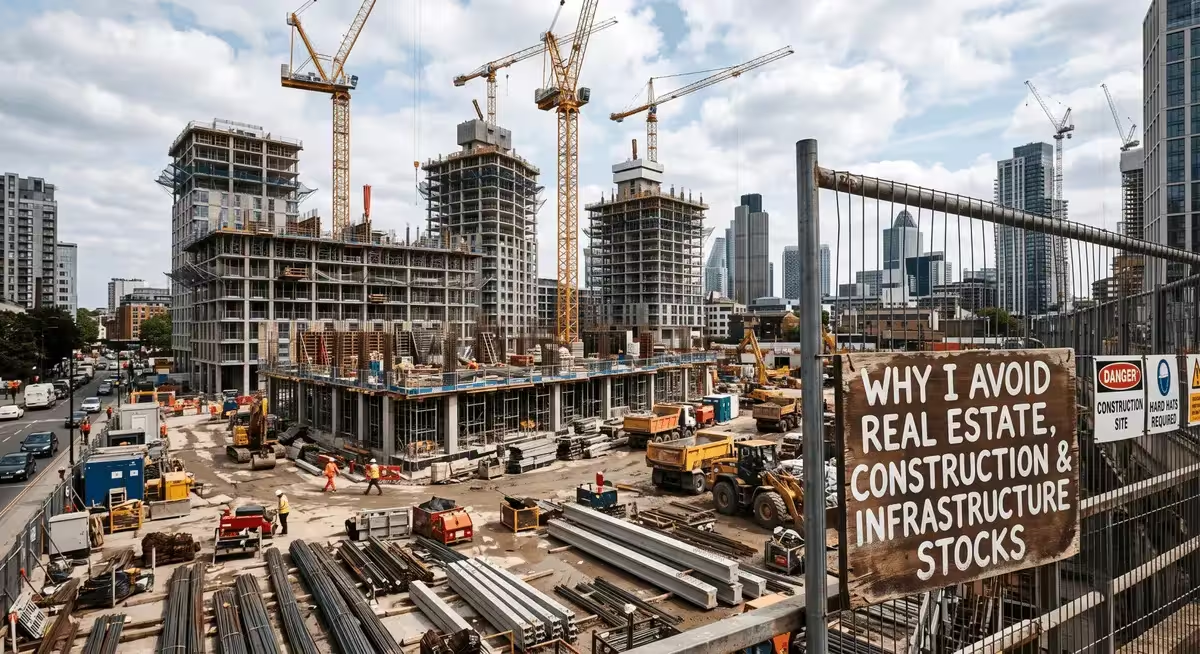
Why I Avoid Real Estate, Construction and Infrastructure Stocks?
Preface
We Indians have a craze for gold and real estate. Hence real estate, housing, construction, and infrastructure stocks had been the darlings of the market a few years back. However, those stocks lost fancy of the investors over time due to poor performance and excessive debt. With the interest rates peaking out now and may be on a downward spiral, a couple of my friends would like to jump into that boat again now.
Why I avoid real estate, construction and infrastructure stocks?
I am averse to investing in gold. No value addition can be done to it. Moreover, you need to spend money to safeguard it from being stolen. However, I don’t mind buying real estate physically for myself as long as I am able to develop it and extract a decent return on the invested capital.
Upcoming construction industry boom, land is a nonreproducible asset, and the infrastructure projects have a lifespan of 30 or more years with potentially no competition etc., are the other points stacked against my arguments. All these don’t enthuse owing to the reasons that I cite below.
Overstated Expenses
The housing development, real estate, construction, and infrastructure sectors employ laborers on a daily basis. Almost all purchases and expenses are made through cash transactions in these sectors. Whether it is paying the daily wages to the laborers or the capital purchases such as buying land, cash has a major part. It is easy to fudge and overstate the payrolls, prices, and expenses.
Therefore, it is easy for the promoters to personally pocket the shareholders’ money. It can be vice versa too. If the management wants to jack up the share prices, it is easy to show good bottom-line numbers too . Hence the reported numbers do not truly depict the reality of the underlying business. You are forced to believe whatever numbers the managements report.
Understated Receipts
Both buying and selling of a property is always a dubious affair. In order to evade stamp duty and income tax by the buyer and capital-gains tax by the seller, there is always under reporting of the transaction price. There is always a difference between the market price of a property and the government guideline values. The market price is usually higher than the guideline values.
Thus the official registered value of a property is substantially lower to its market price. The difference between these two values goes as unaccounted money or otherwise black money. This can either be pocketed by the promoters or is at the disposal of the promoters. Being on either side of the equation, whether a buyer or a seller, there is this illegitimate money part that goes unaccounted. Now how do you think the numbers given by the companies would be reliable whenever there is a capital purchase or a sale?
Regulatory Hurdles and Corruption
In India even if you stay well within the limits of law, you have to bribe every level of bureaucracy [1] to get your jobs done in the government offices or to procure government contracts. Infrastructure and real estate are the most corrupt [2] sectors. For a builder, the root of corruption starts [3] at obtaining the necessary approvals. He has to get approvals from multiple government departments.
Thus the builder has to bribe every person in those departments, right from the peon to the minister to get necessary approvals. Right from getting the basic amenities like water, electricity, and sewage connections, one has to bribe for everything that he has to avail from the government. How do you think a builder or a developer would be able to account these illegitimate transactions legitimately?
Proxy Investments
There is a virtual nexus between the corrupt politicians and the mafia with the real estate Moguls. Since black money can be hid safely in real-estate properties, illicit money from politicians, mafia etc., find its way into assets or businesses either directly or round tripping as foreign investments through Mauritius [4]. Rising prices fetch returns for such investments. When elections approach, the money so parked in these sectors find its way out to fund election expenses [5]. Now whom do you think the promoters would be loyal to? Shareholders or the politicians?
Litigation and Long Gestation Periods
There are so many forces at play. More often companies are dragged into the courts of law. Every project on the anvil has lots of ifs and buts to be fulfilled and several knots to be tied. Thus it takes years and years for any project to get completed and find any return on the invested capital. Moreover, raw material prices are on an upward spiral every day.
So, these inevitable delays have a toll on the project costs with multiple upward revisions of costs and estimates. Due to these unforeseen revision of costs, companies are somewhere compelled to borrow to fund the projects. Servicing debt in economic downturns by the firms in these sectors is the toughest dance to perform! As I am averse to debt and litigation, this aspect also fails to enthuse me. Why should you marry uncertainty?
Questionable Integrity of the Promoters
By buying into a company you are actually becoming the partner of its business. As I said above, everything in these sectors are dubious. Even a person with high integrity cannot conduct fair business with proper ethics. He will be caught between a rock and a hard place. Circumstances will push him to unfair practices. Therefore every promoter and his every move has to be looked upon with a skeptical eye. If you are going to suspect your partner and his every move, how is it going to be a healthy relationship?
Conclusion:
As I said above, there is nothing to write home about housing development, infrastructure, real estate, and construction companies. We have a lot of land in India but what we lack is zoned land, an artificial shortage caused by our politicians [6] to safeguard their money and to boost the prices of their investments. Transparency in operations is the least. Government interference is the highest. Dependence on the government and its policies are the highest, whereas those government departments dealing with these sectors are the most corrupt ones.
Things remain murky. Companies fight legal wars in the courts of law everyday. Uncertainty is the order of the day. How could you paint a rosy picture of the future of a company in these sectors? Where will you have peace of mind and a good night’s sleep if you buy one such company? That’s why I simply avoid real estate stocks or rather any company that is into these sectors. Even if it is available at a deep discount to its value, it’s better to pass rather than dig deep. Better safe than sorry!
References:
1. ^ Corruption of bureaucracy in India. www.wikipedia.org. Retrieved February 4, 2015.
2. ^ Bribery and corruption: ground reality in India, a survey by Fraud Investigation & Dispute Services, Ernst and Young LLP. www.ficci.com. Retrieved February 4, 2015.
3. ^ The root evils of India’s real estate sector. www.equitymaster.com. Retrieved February 4, 2015.
4. ^ Ambareesh Baliga. How Listed Companies Launder Money. www.youtube.com. Retrieved February 8, 2015.
5. ^ Devesh Kapur and Milan Vaishnav. Quid Pro Quo: Builders, Politicians, and Election Finance in India – Working Paper 276. www.cgdev.org. Retrieved February 8, 2015.
6. ^ Vishal Khandelwal. Why Real Estate Will Remain Expensive in India. www.safalniveshak.com. Retrieved February 8, 2015.
These companies lack a steady cash flow. They do not have a widening moat. Very much disorganized sort of.