How Retained Profits Beat High Dividend Yields in Wealth Creation?
Introduction: Why a High Dividend Yield Is Not Always a Good Thing
Many investors like dividends. I understand why. Money arriving in your bank account feels tangible, while the benefit of retained earnings is less visible. But if your objective is to build wealth over a long period, a high dividend yield is not automatically a good thing.
The important question is what the company can do with the profits it does not distribute.
If a good business can retain its profits and reinvest them at high rates of return, those profits can compound inside the business for years. You do not receive the cash today, but you continue to own your share of the growing business. That can be far more valuable than receiving a dividend, paying tax on it, and then deciding where to reinvest what is left.
There is another advantage. A dividend brings a tax liability to the shareholder immediately. Retained profits do not. The company has already paid its applicable corporate tax, but there is no additional shareholder-level dividend tax while the money remains inside the business.
That does not mean companies should never pay dividends. It means investors should look at what management can do with retained capital before celebrating a high dividend yield.
Corporate Tax Comes Before the Dividend
A company does not distribute its pre-tax profit to shareholders. It first pays corporate income tax and other applicable taxes. What remains can either be retained in the business or distributed to shareholders.
The exact corporate tax rate depends on the company’s circumstances and the tax regime it has chosen. Under the current rules, domestic companies can be subject to different rates, including 15%, 22%, 25%, or 30%, before surcharge and cess. The Income Tax Department of India provides the applicable rates and conditions.
For an investor, the important point is simpler than the tax table. A rupee of pre-tax profit is not a rupee available for distribution or reinvestment. The company first pays tax. The remaining profit is what management has to allocate.
This is why I prefer to look at what happens to the capital after tax. If management can take the retained capital and earn a high return on it, retaining the money makes sense. If it cannot, there is little reason to keep piling cash into the business.
What Happens When the Company Pays a Dividend?
Once a company pays a dividend, the shareholder receives cash. Under India’s present tax system, dividend income is taxable in the hands of the shareholder at the applicable income-tax rate. The Dividend Distribution Tax that existed earlier was abolished, shifting the tax burden to shareholders.
For a shareholder in a high tax bracket, this can make a substantial difference. Dividend income can attract tax at the applicable slab rate, along with surcharge where applicable and the 4% Health and Education Cess.
So the economic problem is easy to understand. The company’s earnings have already been taxed at the corporate level. If the remaining profit is distributed, the shareholder then pays tax on the dividend received.
That is the tax friction I am talking about.
The 42-Paise Illustration
Let us take an intentionally high-tax example to see how much can disappear.
Suppose a domestic company earns ₹1.00 before corporate tax. Assume, purely for illustration, that the company faces an effective corporate tax rate of 34.94%. After corporate tax, about ₹0.65 remains.
Now suppose the company distributes that ₹0.65 as a dividend and the shareholder faces an effective dividend tax rate of 35.88%. The shareholder is left with about ₹0.42.
₹1.00 of pre-tax profit → approximately ₹0.65 after corporate tax → approximately ₹0.42 after shareholder-level dividend tax.
That means roughly 58% of the original ₹1.00 has gone in the two tax layers in this particular example. The exact numbers will differ from company to company and shareholder to shareholder, but the point remains: distributing profits can create an additional tax leak that retaining them does not.
This is why I do not look at dividend yield in isolation.
Retained Earnings Give the Business More Capital to Work With
Consider two companies that each have ₹100 of post-tax profit available.
Company A pays the entire ₹100 as a dividend. The shareholder receives the dividend after paying the applicable tax.
Company B retains the ₹100 and puts it to work.
If Company B can earn a high return on that ₹100, the benefit compounds without another shareholder-level tax being triggered every year. The shareholder still owns the same percentage of the company, but the business now has more capital generating earnings.
This is the basic reason retained earnings can be so powerful.
Of course, there is an important condition. The company must actually be good at reinvesting capital. Retaining money simply because management does not want to distribute it is not a virtue.
A company that retains ₹100 and earns 5% on it may be doing something far less useful than a company that distributes some of its cash and allows shareholders to deploy it elsewhere at a higher return.
Capital allocation matters more than the dividend policy by itself.
The Compounding Advantage of Retained Profits
Compounding does not require a company to pay you a dividend. In fact, a good company can compound your wealth without paying much of a dividend at all.
Imagine a business that can consistently grow its earnings by 12% a year and reinvest a meaningful portion of those earnings at similar returns. The profits earned in one year become part of the capital base for the next year. Those profits then earn more profits.
If the company instead distributes a large part of those profits, the shareholder receives cash, pays tax on it, and has to find another investment for whatever remains.
The difference may look small in the first few years. It becomes much larger over a couple of decades.
| Year | Retained Growth | Dividend Path |
| 1 | ₹1,12,000 | ₹1,07,440 |
| 5 | ₹1,76,234 | ₹1,43,163 |
| 10 | ₹3,10,585 | ₹2,04,956 |
| 15 | ₹5,47,357 | ₹2,93,420 |
| 20 | ₹9,64,629 | ₹4,20,068 |
This illustration assumes ₹1,00,000 initially, 12% annual growth, and, for the dividend path, a 38% tax on the annual distribution. It is not a forecast. It simply shows what happens when money is allowed to compound inside a business instead of being distributed and taxed along the way.
After 20 years, the difference is substantial. The retained-profit path reaches about ₹9.65 lakh compared with about ₹4.20 lakh in the simplified dividend scenario.
The important point is not the exact number. It is the effect of leaving more capital in the compounding machine for longer.
Warren Buffett has made essentially this point when discussing deferred taxes and the ability to keep more capital working inside a business. In his letters to Berkshire Hathaway shareholders, he described deferred tax liabilities as resembling an interest-free loan from the U.S. Treasury:
In economic terms, the [deferred tax] liability resembles an interest-free loan from the U.S. Treasury.
That is a useful way to think about tax deferral. Money that does not have to leave the investment today can continue working for you until the tax is eventually triggered.
Retained earnings can be used in several ways.
The company can expand existing operations, enter a new market, increase capacity, spend on research and development, strengthen its balance sheet, acquire another business, or simply keep the money available until a good opportunity comes along.
When these investments earn good returns, the company’s future earnings can increase. Over time, the value of the business should increase with those earnings and cash flows. The shareholder benefits through the value of the shares rather than through an annual cash distribution.
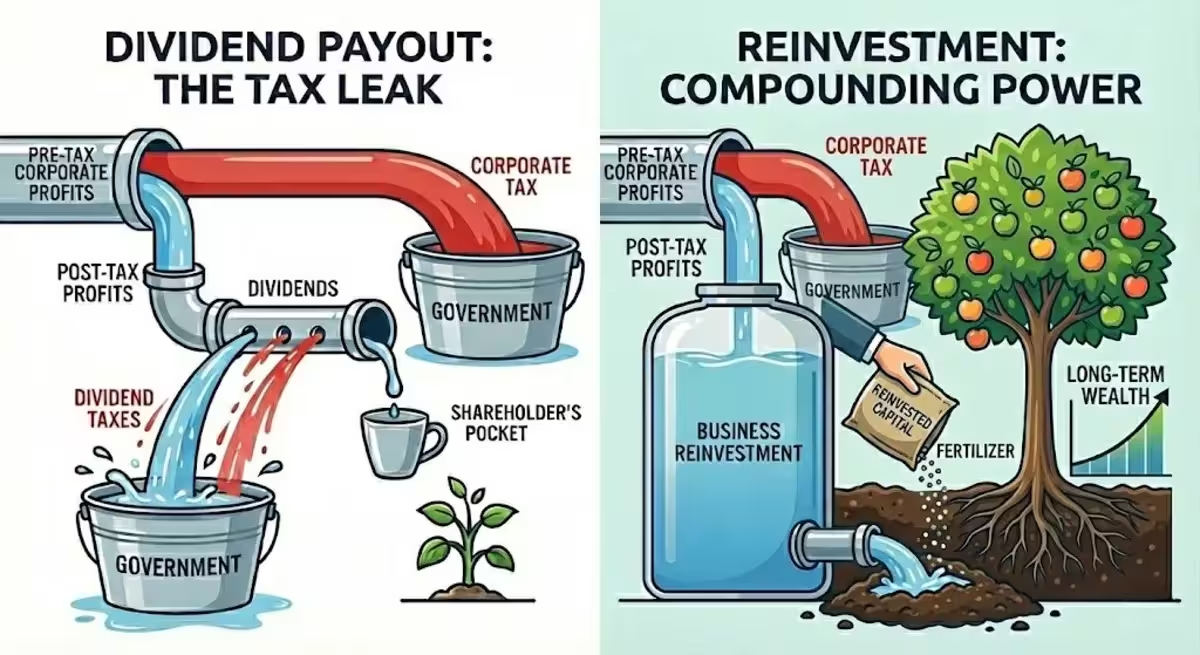
This is where a competitive advantage can develop. A business that repeatedly reinvests at high returns can become larger, stronger, and more difficult to compete with.
But do not confuse retention with value creation. A company can retain every rupee it earns and still destroy shareholder wealth if management invests that money badly.
That distinction is critical.
Retained Earnings Only Work When Management Allocates Capital Well
This is where I spend most of my attention as an investor.
I want to know what management has done with the profits it retained in previous years. Did earnings grow? Did return ratios remain healthy? Did the company build a stronger competitive position? Did free cash flow improve? Did acquisitions create value or simply make the company bigger?
A high Return on Equity or Return on Capital Employed can be useful evidence, but you have to understand why the number is high. A company can show a high ROE because it has very little equity or carries a lot of debt. The number by itself does not tell you enough.
You can use Screener.in to examine financial ratios, but the numbers are only the starting point. I would still go through the annual reports and understand where the money actually went.
If management cannot find productive uses for the money, I would rather receive the cash and make my own allocation decision.
There is no prize for a company that keeps cash on its balance sheet forever.
The Real Return Hurdle
There is another issue that investors often ignore: inflation.
If inflation is 7%, a business cannot create meaningful real wealth by merely earning 7% before tax. It has to earn more than that because corporate taxes take a part of the return.
For example, assume an effective corporate tax rate of 34.94% purely for illustration. If the business needs to generate 7% after tax to maintain purchasing power, the pre-tax return required would be:
Pre-Tax Return Hurdle = Inflation Rate / (1 – Effective Tax Rate)
7% / (1 – 0.3494) = approximately 10.76%
So, under these assumptions, the business would need to earn about 10.76% before tax just to produce a 7% return after tax.
I would not call 10.76% an ROE floor. ROE is generally a post-tax measure. This is simply a pre-tax return hurdle under the assumptions used above.
The broader point is more important than the exact number. A business must earn a healthy return on the capital it retains if it wants to create wealth after tax and inflation.
This is one of the reasons behind the sectors and industries I avoid. Some businesses simply do not have the economics required to compound capital at attractive rates over long periods.
Why I Look for High Returns on Reinvested Capital
If a company can consistently reinvest its profits at 15%, 20%, or higher returns without taking excessive risk, I pay attention.
That kind of business does not need to distribute all its profits to create value for shareholders. The retained earnings themselves become the fuel for future growth.
But consistency matters. I am not interested in one exceptional year followed by mediocre returns for the next five years. I want to see what management has actually done with shareholders’ money over a long period.
This is why capital allocation deserves as much attention as revenue growth or earnings growth. A company can grow rapidly and still destroy value if it continually reinvests at poor returns.
My stock-investing checklist includes the return and financial metrics I consider important when evaluating a business.
There is one more advantage to retained earnings: timing.
If a company pays you a dividend, the tax event happens when you receive the dividend. You do not get to postpone it simply because you would rather keep the money invested.
With retained earnings, there is no shareholder-level dividend tax while the profits remain inside the company. If the business continues to grow, you can remain invested without creating a personal tax event every time the company earns a profit.
Eventually, you may sell the shares and realize a capital gain. At that point, capital-gains tax becomes relevant. Under the current rules, listed-equity long-term capital gains are taxed at a different rate from dividend income, subject to the applicable conditions and exemption threshold.
The important difference is that you generally have control over when you sell. You do not have that same control over a dividend declared by the company.
For a long-term investor, deferring a tax payment for many years can have real value because the money that would otherwise have gone out in tax remains invested.
A High Dividend Yield Can Sometimes Be a Warning Sign
I would be careful about looking at a high dividend yield and immediately treating it as evidence of a good investment.
Sometimes the yield is high because the business is genuinely generating more cash than it needs. That can be perfectly sensible.
But sometimes the share price has fallen sharply and the dividend yield only looks high because the denominator has collapsed. In other cases, the company may be distributing money that would be better used to strengthen the business.
The opposite can also be true. A company paying little or no dividend may be an excellent investment if it can reinvest its earnings at high returns for many years.
The question I would ask is simple:
What can management do with the next rupee of retained profit?
If the answer is “earn a high return and grow the business,” I am happy for the company to retain it.
If the answer is “sit on cash, make mediocre acquisitions, or invest in projects that earn poor returns,” then I would rather have the money back.
Conclusion: Do Not Confuse Dividends With Wealth Creation
Dividends are not bad. There are many good businesses where paying dividends is the right capital-allocation decision. But a high dividend yield by itself tells me very little about the quality of an investment.
What matters is what the company does with the capital it retains.
If management can reinvest profits at high returns, retained earnings can compound inside the business for many years. The shareholder continues to own the growing business without paying personal tax on dividends that were never received.
That is the tax and compounding advantage of retained profits.
But there is no free lunch here. Retaining profits only creates value when management allocates the money intelligently. A company that earns a high return on retained capital can be a wonderful compounder. A company that earns poor returns on retained capital can destroy value even if it never pays a dividend.
As a long-term investor, I would rather own a business that can take ₹1 of retained earnings and turn it into significantly more than ₹1 over time than one that simply hands me the ₹1 and asks me to figure out what to do with it.
That is the real difference between a dividend payer and a compounding business.
Did You Read The Disclaimer?
Not a SEBI-Registered Research Analyst or Investment Adviser
I am not a SEBI-registered Research Analyst or Investment Adviser. Raj & Co is an independent educational and informational website. All articles, views, opinions, observations, analyses and other content published on this website are provided solely for general informational and educational purposes.
Nothing published on this website constitutes investment advice, financial advice, research advice, a research report, a recommendation, solicitation, offer, endorsement or invitation to buy, sell, subscribe to, hold or otherwise deal in any security, financial product or investment strategy. The content is not tailored to any individual’s financial circumstances, investment objectives, risk tolerance or other personal circumstances.
Any discussion of a company, security, market, investment strategy, price, valuation, historical performance or other investment-related matter is intended solely for educational discussion and should not be interpreted as a recommendation or prediction of future performance. References to particular securities or investments do not constitute recommendations to buy, sell, or hold them.
I may personally buy, sell, hold or change my views or positions in securities at any time. Such personal transactions or changes in views do not constitute recommendations to readers. Where I disclose such positions or changes, the disclosure may occur after a transaction has been executed and may not be immediate.
Investment in the securities market is subject to market risks. Past performance is not indicative of future results. Readers should conduct their own independent research and due diligence and consider their own financial circumstances, investment objectives and risk tolerance before making any investment decision. If personalized financial advice is required, consult a financial adviser or other professional appropriately registered with SEBI.
No representation or warranty is made regarding the accuracy, completeness, timeliness or reliability of any information published on this website, and no responsibility is accepted for any loss arising from reliance upon such information to the extent permitted by applicable law.
SEBI’s investor education initiatives emphasize informed investing, financial literacy, risk awareness, and disciplined long-term wealth creation.
E & O E.
Good post , unable to contact you , kindly reply to my mail , . I have queries regarding medical dictionary
Sorry. I didn’t get your mail.
I don’t update the medical spell checker nowadays.
For anything else, you may reach me through the contact page.