Preventive Health Checkups: What Is in It for You as an Investor?
Preface
As an investor, I spend a great deal of time thinking about risks that can permanently destroy capital. But there is another asset that deserves the same attention: our health.
Money can compound for decades, but only if we are around and healthy enough to benefit from that compounding. That is one reason I have made preventive health checkups a regular part of my life since crossing 40. I usually schedule one around my birthday. A birthday reminds me not only that another year has passed, but also that another year of my investing journey has been completed.
A preventive health checkup is not a guarantee against illness, nor does every person need the same battery of tests every year. Its purpose is more practical: to identify health risks early enough for you and your doctor to decide whether anything needs attention.
For a long-term investor, I believe that is a worthwhile investment of both time and money.
Think of health as an asset
Investors understand the importance of maintaining an asset before a small problem becomes a major one. We inspect a business, study its financial statements, watch its cash flows and keep an eye on risks. We do not wait for a company to collapse before asking what went wrong.
Our body deserves a similar attitude.
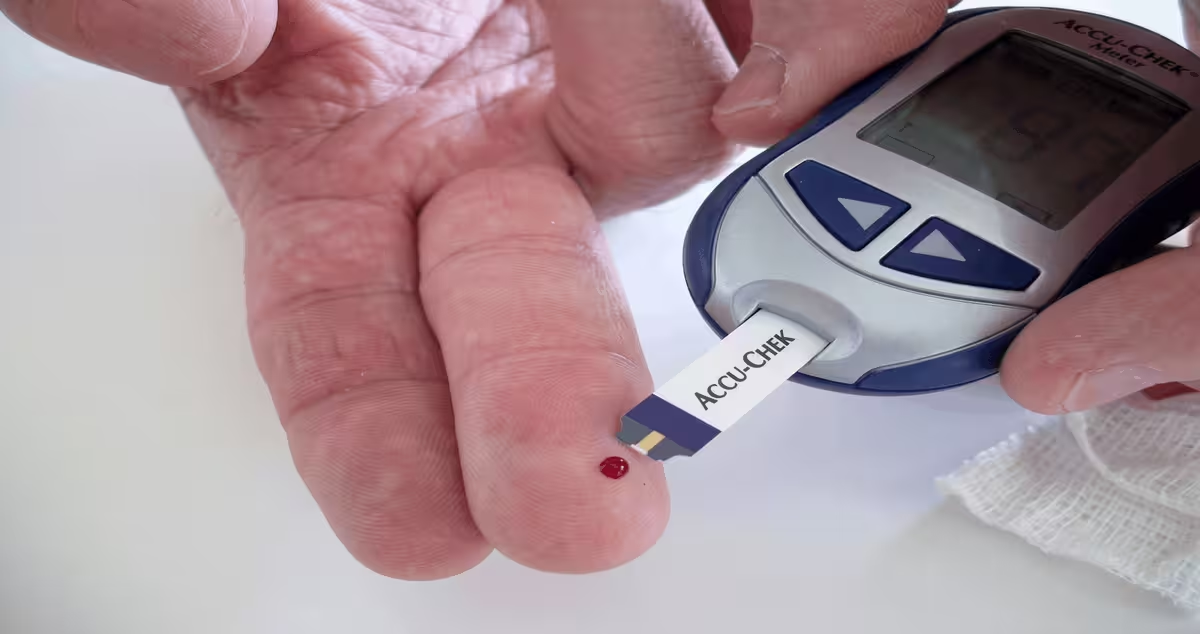
Some health problems develop silently. Blood pressure, blood sugar, abnormal cholesterol levels, and several other risk factors may not produce obvious symptoms in their early stages. A person can therefore feel perfectly fine while an important risk is developing in the background.
A preventive health checkup can provide useful information about where you stand. If something is abnormal or borderline, your doctor can decide whether it needs monitoring, further investigation or a change in diet, exercise, medication, or other aspects of your lifestyle.
Prevention is better than waiting for a problem
We often think of healthcare only when we become ill. That is understandable, but it is not always the best strategy.
Many important health risks are influenced by things we can do something about: physical inactivity, excess weight, smoking, excessive alcohol consumption, poor diet, inadequate sleep, and uncontrolled blood pressure or blood sugar, among others. Knowing where you stand gives you an opportunity to address a problem before it becomes more difficult to manage.
That does not mean that every disease can be prevented. Genetics, age, and chance also matter. Nor does a normal checkup mean that you will never become ill. The value of preventive healthcare is that it can improve the odds of finding certain problems early and help you make better decisions about your health.
Do not confuse preventive care with unnecessary testing
There is an important distinction here. A preventive health checkup does not mean ordering every test available.
More testing is not necessarily better healthcare. Some tests can produce false alarms, leading to unnecessary anxiety, additional investigations, and expenses. Certain imaging procedures also involve radiation exposure and should not be repeated simply because they are included in a package.
The sensible approach is to discuss your age, family history, existing health risks, symptoms, lifestyle, and previous test results with your doctor, and undergo the screening that is appropriate for you. The Mayo Clinic’s adult preventive care schedule is a useful reference for understanding which preventive screenings may be appropriate at different ages.
In other words, do not buy a health-checkup package merely because it contains 50 or 100 tests. Buy the right healthcare, not the largest number of tests.
Early information gives you more choices
One of the greatest advantages of knowing about a problem early is not simply that treatment may begin earlier. It is that you have more choices.
A borderline result may be an opportunity to improve your diet, exercise more, lose excess weight, sleep better, or stop smoking. A doctor may recommend monitoring rather than immediate treatment. Another finding may require further investigation.
The important point is that information received early gives you time to act. Ignoring a problem does not make the problem disappear; it merely removes some of the time available to deal with it.
It can protect your financial life too
Healthcare is not only a medical issue. It can become a financial issue as well.
A serious illness can result in hospital bills, medicines, loss of income, and considerable disruption to a family’s finances. Health insurance is an important part of protecting against large medical expenses, but insurance does not prevent illness or eliminate the personal and financial consequences of becoming seriously ill.
For an investor, protecting against an avoidable financial setback is part of sensible risk management. Maintaining good health, getting appropriate preventive care, and carrying adequate health insurance are complementary measures—not substitutes for one another.
The investor’s most valuable asset is time
Now comes the part that matters most to me as a long-term investor.
We know that compounding needs time. The longer good investments are allowed to compound, the greater the opportunity for wealth to grow.
But there is another form of compounding that we rarely discuss: the compounding of years.
An investor who starts early and remains invested for decades has an enormous advantage over someone who repeatedly interrupts the process. The same principle applies to health. Every healthy year gives you another year in which you can work, invest, learn, enjoy your family, and allow your existing investments to compound.
This is why I do not look at a preventive health checkup simply as an expense. I see it as one small part of protecting the time required for long-term investing to work.
Do not postpone your health for your wealth
There is an irony in the way some investors approach money. We may spend hours analyzing a company’s balance sheet to protect our capital, yet neglect the asset that allows us to enjoy that capital.
There is little point in accumulating wealth for decades if poor health prevents you from enjoying it.
This does not mean becoming obsessed with medical tests or trying to eliminate every possible health risk. That would be impossible. It means adopting the same sensible principle that works in investing: pay attention to important risks before they become irreversible problems.
Conclusion
Long-term investing is ultimately a game of time. We save, invest patiently, and allow compounding to do its work. But time itself is an asset, and our ability to use that time depends partly on our health.
A preventive health checkup cannot guarantee a long life and should never be treated as a substitute for a healthy lifestyle or appropriate medical care. But getting the right preventive care at the right intervals can help identify certain risks early and give you an opportunity to act.
So, as an investor, I would put preventive healthcare in the same broad category as insurance and risk management. It is not about predicting what will go wrong. It is about being prepared for what might.
We invest for the future. We should also take care of the person who is going to live in that future.
It is also advisable to go for a health insurance policy that includes your dependents as early as you can and keeping it live.