6 Financial Literacy Lessons Every Parent Should Teach Their Child
Why Financial Literacy Should Begin at Home
Schools can introduce children to financial concepts, but practical financial wisdom is not learned from textbooks alone. Knowing how to calculate percentages is not the same as knowing how to manage a salary, control spending, use debt responsibly, save for the future, or invest for long-term goals.
Financial literacy is increasingly recognized as an important life skill. The National Centre for Financial Education (NCFE), established by the financial-sector regulators in India, describes financial literacy in terms of the knowledge, behavior, and attitudes required to make responsible money-management decisions. Its financial education initiatives for school students cover areas such as money management, saving, investing, borrowing, risk, and consumer protection.
Financial behavior is shaped by much more than financial knowledge. Our emotions, impulses, social pressures, desire to keep up with others, and attitudes toward money can influence the financial decisions we make throughout our lives. A child who understands money only in theory may still grow into an adult who struggles to manage it.
That is why financial literacy should begin at home. Parents have an opportunity to teach children not only what money is, but also how to think about it. Children observe how their parents earn, spend, save, borrow, invest, and respond to financial setbacks. Those observations can become lifelong habits.
Financial wisdom can certainly be learned later in life through experience and self-education. But learning sound principles early can save a child from making expensive mistakes as an adult. The objective is not to raise a child obsessed with money or wealth. It is to raise an adult who understands money well enough to use it responsibly and make independent financial decisions.
How Parents Can Teach Financial Literacy
Be a Financial Role Model
Children learn by observing. The way you handle money can teach your child more than any lecture on personal finance. If you spend impulsively, constantly borrow to fund wants, or treat saving and investing as unimportant, your child may absorb those behaviors. If you plan your spending, live within your means, save regularly, and make thoughtful financial decisions, you demonstrate those habits in practice.
You do not have to be financially perfect to be a good role model. In fact, acknowledging your own mistakes can be an important part of financial education. Explain what you learned from a poor financial decision and what you would do differently today.
Give Children Age-Appropriate Responsibility
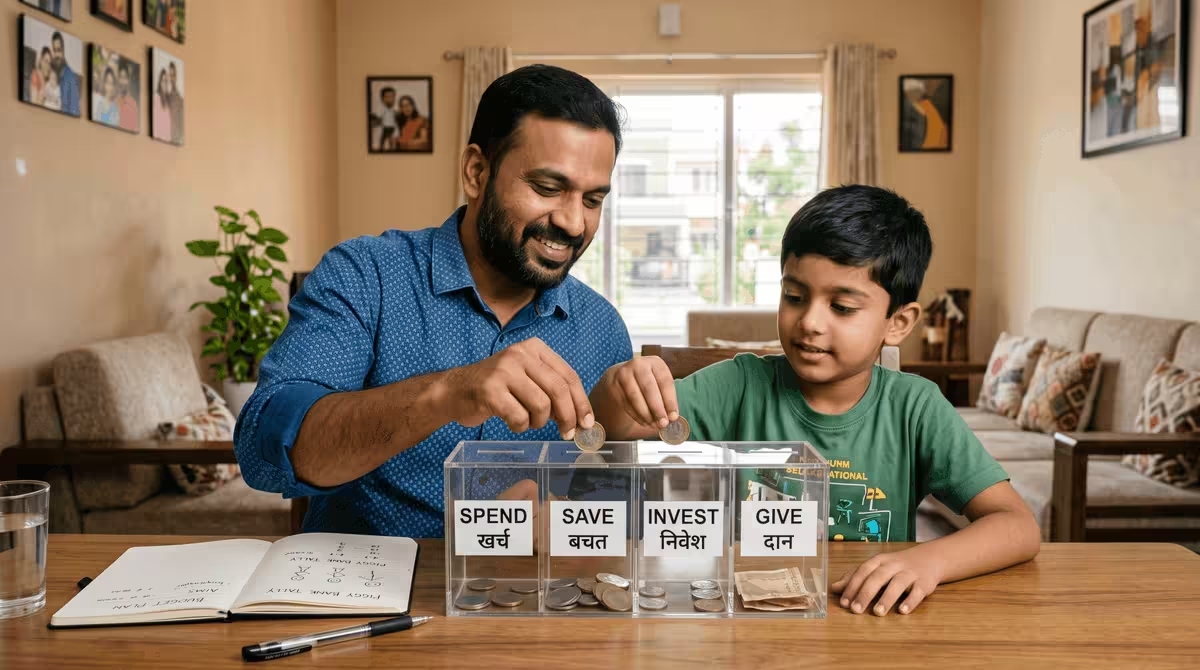
Financial literacy becomes meaningful when children have an opportunity to make decisions with money. A small allowance or pocket-money budget can be a useful starting point. Let the child decide how much to spend, how much to save, and what they are willing to postpone buying.
As children grow older, gradually increase their financial responsibilities. They can learn to compare prices, maintain a simple budget, save for a specific goal, understand a bank account, and eventually manage larger financial decisions. The objective is to gradually transfer responsibility rather than manage every financial decision for them.
Let Them Learn From Small Mistakes
A child who spends all of their pocket money on something they later regret has learned a valuable lesson if they are allowed to experience the consequence. Small financial mistakes made under parental guidance are far less costly than major mistakes made for the first time as an independent adult.
Instead of immediately correcting every poor decision, ask questions. Was the purchase necessary? Was there a better use for the money? Would the child make the same decision again? Such conversations help develop financial judgment rather than simple obedience.
Talk Openly About Money
Money should not be a subject that children learn about only after they become adults. Parents can have age-appropriate conversations about earning, spending, saving, debt, investing, and financial priorities without exposing children to information they are not ready to handle.
As children become teenagers, conversations can become more sophisticated. Explain how a salary is earned, why taxes and other deductions reduce take-home pay, why borrowing costs money, why investments fluctuate, and why financial decisions often involve trade-offs.
Experience is one of the best teachers, and parents can give their children the benefit of experiences they have already had. Talk about financial decisions that worked and those that did not. Explain why you made those decisions and what you learned from them.
Encourage children to learn beyond the family as well. Books, reliable educational resources, and firsthand experience can gradually expand their understanding of money. Financial wisdom is not acquired in a single lesson; it develops through years of learning and applying sound principles.
6 Financial Literacy Lessons Every Child Should Learn
1. Learn the Value of Earning
Money does not appear by itself. It is generally earned by providing useful goods, services, skills, or capital. Children should understand from an early age that income is a consequence of creating value and that increasing one’s earning capacity usually requires developing useful skills.
As children grow older, encourage them to think about what they enjoy, what they are good at, and what skills are valuable in the marketplace. Whether they eventually become employees, professionals, entrepreneurs, or investors, the ability to create value and earn an income is an important foundation of financial independence.
Teach them, too, that a high income by itself does not guarantee financial security. What matters is what happens to that income after it is earned.
2. Learn to Manage What You Earn
Earning money is only the beginning. A financially responsible person must decide how that money will be allocated among current spending, saving, investing, and other financial obligations.
Teach children the difference between needs and wants. Help them understand delayed gratification: something that can be bought today does not necessarily have to be bought today. Learning to postpone a purchase in order to achieve a more important goal is one of the most useful financial habits a child can develop.
The importance of delayed gratification has been illustrated by the famous marshmallow experiment, in which children were offered a choice between a smaller immediate reward and a larger reward if they waited. The experiment became widely known as an example of self-control and the ability to delay gratification. Later research, however, suggests that the story is more nuanced than the popular version implies. A child’s ability to wait can be influenced by factors such as their environment and their expectations about whether the promised reward will actually arrive.
However, the financial lesson remains valuable: learning to distinguish between what you want now and what you want more in the future is an important part of managing money. Saving for a meaningful goal requires giving up some immediate consumption in exchange for a future benefit.
Introduce the idea of budgeting early. A budget does not have to be complicated. Even a simple record of money received and money spent can show a child where their money is going. As income and responsibilities increase, the same basic principle remains: spend deliberately rather than allowing spending to happen without thought.
Living within your means is one of the simplest and most powerful financial principles. It creates room for saving, investing, and dealing with unexpected expenses.
3. Understand Debt Before You Borrow
Borrowing money means committing future income to repay today’s spending. Children should understand this before they begin using credit cards, personal loans, or other forms of consumer credit.
Debt is not automatically bad. Borrowing can sometimes be useful when it serves a sound purpose and the borrower has a realistic ability to repay it. The danger arises when people borrow unnecessarily, borrow to fund consumption they cannot afford, or underestimate the cost of interest and repayment.
High-cost consumer debt deserves particular caution. Interest can work against you just as compounding can work for you when you invest. Credit-card debt, in particular, can become difficult to repay when balances are carried from month to month.
Teach children an important distinction: being offered credit does not mean that you can afford to spend it.
Understanding this principle early can help them avoid the debt trap created by expensive credit-card debt.
4. Save for Goals and Emergencies
Saving teaches a child that money can have a purpose beyond immediate consumption. Encourage children to save for something they genuinely want rather than simply telling them that saving is good. Having a goal makes the concept tangible.
As they grow older, introduce a second purpose for savings: preparing for the unexpected. Adults need money that is readily available when an emergency occurs, and children should eventually understand why an emergency reserve is different from money invested for long-term growth.
An emergency fund is not intended to generate the highest possible return. Its primary purpose is to provide financial resilience and quick access to money when it is needed. You can learn more about how much an emergency fund should contain and where to keep it.
The broader lesson is simple: money should be saved with a purpose, and different financial goals may require different approaches.
5. Learn How Investing Builds Wealth
Saving protects money for future use, but long-term wealth building requires understanding how productive assets can grow in value over time. This is where children should gradually be introduced to investing.
Start with the basic idea of compounding. Money that earns a return can generate additional returns, and over long periods this can become a powerful force. Time matters because compounding needs time to work.
Children should also learn that investment returns are not guaranteed. Risk and return are connected, and different asset classes carry different levels and types of risk. Investing therefore requires understanding what you own, why you own it, and what could go wrong.
As children become old enough to understand businesses, introduce them to the idea of owning productive assets. A stock is not merely a number moving up and down on a screen; it represents fractional ownership of a business. Teach them to look beyond stock prices and understand how businesses make money, allocate capital, generate profits, and produce cash flow.
Learning the basics of financial statements can eventually help them understand businesses more deeply. The balance sheet, income statement, and cash flow statement are useful tools for understanding the economics of a company.
Most importantly, teach them the difference between long-term investing and speculation. Building wealth through ownership of productive assets requires patience. It does not require constantly buying and selling because prices have moved.
Over a sufficiently long period, retained profits can be a powerful source of wealth creation when a business can reinvest them at attractive rates of return.
6. Protect Your Money and Think Independently
Financial literacy is not complete without learning how to protect the money you have accumulated. Children growing up in a digital economy will encounter financial offers, advertisements, investment ideas, and potential scams from an early age.
Teach them to be skeptical of promises that sound too good to be true. They should learn to ask who is offering an investment, how the investment actually generates a return, what risks are involved, what fees are being charged, and what could cause them to lose money.
They should also understand the importance of protecting financial information, passwords, account credentials, and other sensitive information. Financial fraud can destroy wealth just as surely as poor investment decisions can.
Perhaps the most important lesson is to think independently. Friends, relatives, colleagues, social media personalities, and even well-meaning people can offer financial opinions. Teach children to examine the reasoning and evidence behind financial decisions instead of blindly following someone else’s advice.
Teach Financial Lessons According to Age
Financial education does not need to happen all at once. The lessons should become more sophisticated as the child grows and gains greater responsibility.
| Age | Financial lessons to introduce |
|---|---|
| 5–8 | What money is, spending choices, needs versus wants, and saving for something they want |
| 9–12 | Pocket money, simple budgeting, comparing prices, saving goals, and delayed gratification |
| 13–17 | Banking, digital payments, budgeting, interest, debt, investing basics, scams, and financial responsibility |
| 18 and above | Income, taxes, credit, insurance, investing, financial independence, and long-term financial planning |
These age ranges are only a practical framework. Every child develops differently, and parents can introduce each concept when the child is ready to understand and apply it.
Financial Wisdom Is Learned, Not Inherited
Financial literacy is more than knowing definitions such as income, savings, debt, or investments. The real objective is to develop sound financial judgment.
Schools can provide academic knowledge, but children also need practical lessons that connect money to everyday decisions. Parents can provide many of those lessons simply by involving children in appropriate financial conversations and allowing them to observe responsible behavior.
For those who did not receive financial education at home, it is never too late to learn. Books, reliable educational resources, and real-world experience can help anyone develop better financial habits. The important thing is to recognize that financial wisdom has to be learned deliberately rather than assumed to develop automatically with age.
The ultimate goal is not to teach children how to become rich. It is to teach them how to earn responsibly, spend thoughtfully, save consistently, borrow cautiously, invest patiently, protect their money, and make financial decisions without being controlled by impulse or social pressure.
Give a child those principles early, and you give them something far more valuable than a lesson about money: you give them a foundation for financial independence.