Diversified vs Concentrated Portfolio: Which Gives High Returns?
Preface
As you know, I have been an advocate of concentrated investing for quite some time now.
Among friends, I used to jokingly refer to each stock as a wife. The more you have, the more trouble you have! My point was simple: just as you would want to know your life partner well, you should know the business you own. You should understand the company, its business economics, management and, above all, the integrity of the management before you buy its stock.
It is better to own what you know best than to own a long list of businesses you barely understand.
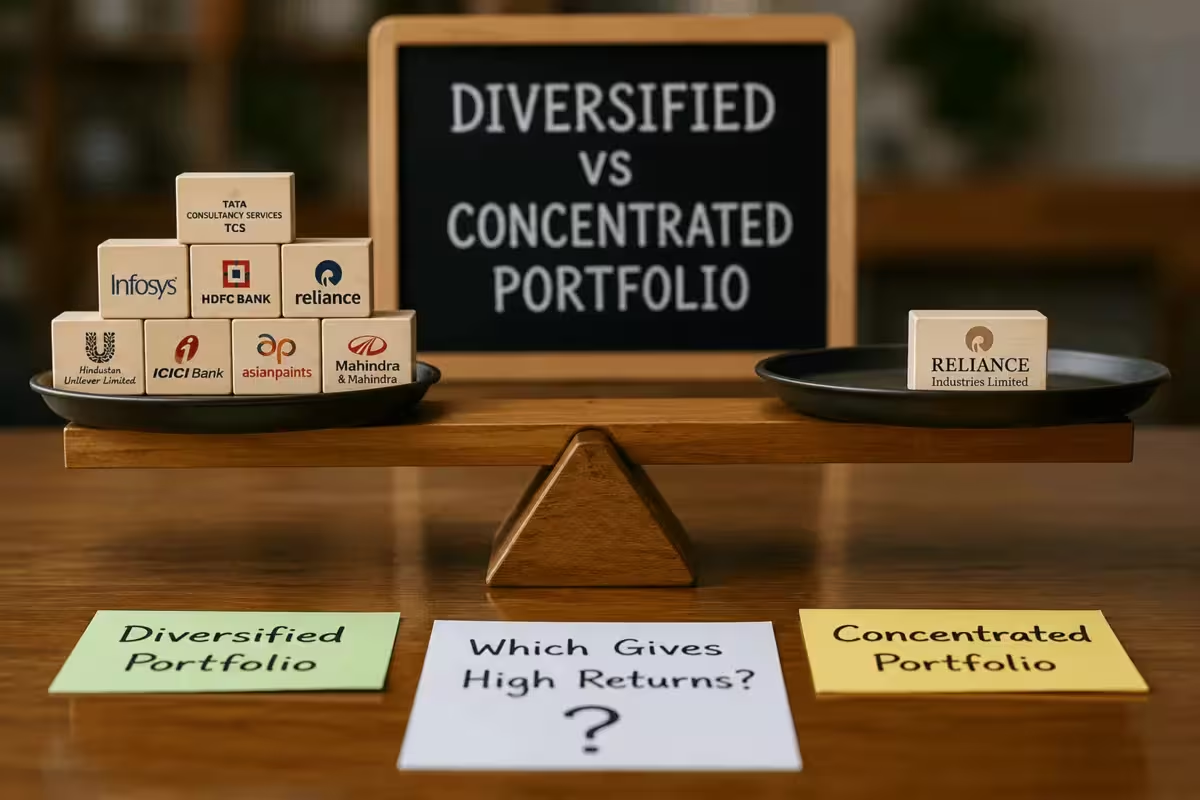
That brings us to the curious question of diversified vs concentrated portfolio. Which approach can produce better long-term returns?
Diversified vs concentrated portfolio: The real question
Citing this Economic Times article, one of my friends once asked me:
“Raj, all the investors mentioned in that article have hundreds of companies in their portfolios. So what do you say now about your ‘many wives’ theory?”
Good question.
But before answering, we must distinguish between diversification and diworsification.
Diversification means owning enough businesses to reduce the damage that a single mistake can cause to your portfolio. Diworsification is simply owning more and more stocks without any improvement in the quality of your portfolio, merely because you believe more stocks automatically mean less risk.
Similarly, concentration does not automatically mean wisdom. A concentrated portfolio can produce extraordinary returns when the investor is exceptionally right. It can also produce disastrous results when the investor is exceptionally wrong.
So the real question is not whether concentration is always better than diversification. The real question is:
How many businesses can you genuinely understand, value and monitor?
The answer will be different for different investors.
Burton Malkiel, in his book A Random Walk Down Wall Street, famously argued that investors can obtain good long-term results without trying to identify individual winners:
Investors who select a portfolio of stocks by throwing darts at the stock listings in the Wall Street Journal can make fairly handsome long-run returns. What is hard to avoid is the alluring temptation to throw your money away on short, get-rich-quick speculative binges.
The point is that a broad basket of stocks can provide reasonable long-term returns. Where many investors go wrong is not necessarily through diversification, but through speculation, stock tips, penny stocks and the constant temptation to get rich quickly.
Why concentration can create great wealth
Look at many of the world’s greatest fortunes. Narayana Murthy, Mukesh Ambani, Dilip Shanghvi, Lakshmi Mittal, Shiv Nadar, Azim Premji, Bill Gates, Warren Buffett, Jeff Bezos and Carlos Slim built enormous wealth primarily through concentration in businesses they knew extremely well.
Their fortunes were not created by owning 500 businesses in equal amounts. They were generally created by having substantial ownership in a relatively small number of exceptional businesses.
That does not mean all of their wealth remains concentrated in one asset today. Wealth created through concentration may later be diversified. But the principle remains interesting:
Great wealth is often created through concentration. Wealth preservation may require more diversification.
This is also one reason why the concentrated investor must be careful when comparing himself with a founder or business owner. A founder may know one business more deeply than any outside investor ever can. Buying one listed stock is not the same as founding and running that company.
The advantage of concentration
If you are a know-something investor, able to understand business economics and to find five to ten sensibly-priced companies that possess important long-term competitive advantages, conventional diversification makes no sense for you. It is apt simply to hurt your results and increase your risk. I cannot understand why an investor of that sort elects to put money into a business that is his 20th favorite rather than simply adding that money to his top choices – the businesses he understands best and that present the least risk, along with the greatest profit potential. In the words of the prophet Mae West, Too much of a good thing can be wonderful.
— Warren Buffett
All businesses are not equally profitable. They do not have the same economics, competitive advantages, growth prospects or quality of management.
If you want returns superior to the market over the long term, you cannot simply assume that every stock deserves the same allocation. If you genuinely find a handful of exceptional businesses at sensible prices, allocating more money to your best ideas can make logical sense.
But there is a big condition: you must actually know what you are doing.
To identify an exceptional business, you must first know a lot about the businesses available to you. You must understand what makes one business wonderful and another mediocre. You must know what you know—and, equally importantly, know what you do not know.
That requires intellectual honesty. It also requires study.
Read, read and read. Study businesses. Read annual reports. Study financial statements. Learn how good businesses generate cash, how they allocate capital and how management behaves when things go wrong.
Stay well within your circle of competence.
I can already hear you saying: “Come on, Raj. I am already busy with my job and cannot find the time!”
Fair enough. But then you should ask yourself whether concentrated stock picking is really the right approach for you.
It is your hard-earned money. And nobody can manage it responsibly unless you either develop the necessary knowledge yourself or choose a simple investment approach that does not require you to become a full-time analyst.
If you are unwilling or unable to do the work, there is nothing wrong with owning a low-cost diversified index fund.
The problem with owning too many stocks
Too often investors throw money around like scattering seed, saying to themselves, “I’ll throw a little here and little there to see what happens.”
— Warren Buffett
This is where diversification can quietly become diworsification.
Suppose you own 1,000 stocks.
Do you read the annual reports of those companies? Do you follow major acquisitions, changes in management, capital allocation decisions, governance issues, competitive developments and quarterly results?
Let us make an extremely generous assumption. Suppose you spend only one hour a year reviewing each company you own.
1,000 companies × 1 hour = 1,000 hours.
That is already more than 41 full days of continuous work. And one hour per company per year is nowhere near enough for a serious investor.
Now add quarterly results, annual reports, major announcements, changes in management and other developments. The monitoring burden becomes enormous.
The problem is not that diversification is bad. The problem is pretending that you can intelligently monitor more businesses than your time and knowledge actually allow.
My old joke about stocks being wives was intended to illustrate precisely this point. The more businesses you own, the less attention you can give to each of them.
A business you have forgotten after buying its stock is not necessarily a bad investment. But forgetting to monitor it while still believing that you understand the business is something else altogether.
Diversification is not diworsification
Let me be clear. I am not arguing that every investor should put all his money into one stock.
That would be foolish advice because the risk of being wrong about a single company can be catastrophic. Businesses can be disrupted. Managements can make terrible decisions. Accounting can mislead. Regulations can change. A seemingly permanent competitive advantage can disappear.
Even the best analysis cannot eliminate the possibility of being wrong.
That is why sensible diversification has an important purpose: it protects you from your own mistakes.
The mistake is to believe that diversification automatically improves a portfolio without limit.
There is a difference between owning five businesses you understand and owning 500 businesses you barely know.
There is also a difference between owning your best ideas and simply throwing money at every stock that looks interesting.
Diversification protects you from being disastrously wrong. Concentration rewards you when you are exceptionally right.
The problem is that most investors tend to overestimate their ability to know when they are exceptionally right.
How should you diversify?
If you still want to diversify, how should you do it?
I would not begin with a target number of stocks. I would begin with businesses.
Buy one good business at a time. Do not buy a stock merely because your portfolio “needs another stock.” Wait until you find a business you understand and like at a price that offers a reasonable margin of safety.
If an exceptional business temporarily goes out of favour and becomes available below your reasonable estimate of intrinsic value, it may deserve a significant allocation. You do not need to use leverage. You do not need to rush. And you certainly do not need to buy something else merely because you have cash waiting.
Once the stock becomes seriously overvalued, reassess the situation. The right decision may be to sell, reduce the position or simply continue holding. It depends on the business, valuation, taxes and available alternatives.
Then wait.
Perhaps the next truly attractive opportunity will come in two years. Perhaps three. Perhaps longer.
That is perfectly fine.
Keep your capital available until another fat pitch arrives. Newspapers, business channels, magazines, websites, investor groups and market experts may constantly tempt you to act. But patience is often one of the greatest advantages available to an individual investor.
You do not have to swing at every pitch.
When another wonderful business becomes available at an attractive price, study it. If it belongs within your circle of competence and your conviction is based on careful analysis rather than excitement, you can allocate capital accordingly.
That is how, in my view, you can gradually build wealth over the long term: not by owning the maximum possible number of stocks, but by patiently owning businesses you understand.
Concentration requires humility
This may sound contradictory, but a concentrated investor needs more humility, not less.
Having high conviction is not the same thing as being certain.
You can study a business for months and still be wrong. You can admire a management team and later discover that your judgment was mistaken. You can estimate intrinsic value carefully and still see the business change in ways you never anticipated.
Therefore, concentration should never be based merely on confidence. It should be based on knowledge, analysis, valuation and a clear understanding of what could go wrong.
If you are unable to explain why you own a stock, what could invalidate your thesis and what you would do if circumstances change, you probably do not have enough conviction to justify a concentrated position.
And there is nothing wrong with admitting that.
My answer to my friend
So what did I tell my friend who showed me the article about investors supposedly owning hundreds of companies?
I told him:
“Don’t take everything you read to heart. Sit back and analyze the reality. Unless you know what those portfolios actually contain, how much is invested in each company, and how those investments are managed, a list of hundreds of stocks tells you very little. Read, analyze, smile, and move on.”
There is no magic number of stocks.
For some investors, ten stocks may be too many. For others, ten stocks may be dangerously few. A professional fund manager with a large research team can monitor far more businesses than an individual investor working alone.
The right number depends on your knowledge, available time, experience, temperament and ability to analyse businesses.
Conclusion
If you do not know what you are doing, diversification is not a weakness. It is humility.
If you do not have the time or interest to analyse individual businesses, a low-cost index fund may be the most sensible choice. You can still participate in the long-term wealth creation of equities without pretending to know more than you do.
But if you have developed genuine expertise in analysing businesses and you find a small number of exceptional opportunities within your circle of competence, concentration can become a powerful advantage.
The objective should not be to own the maximum number of stocks or the minimum number of stocks.
The objective should be to own as many businesses as you can understand and monitor properly—and no more.
Concentration is not the opposite of risk. It is the acceptance of a different kind of risk. If you understand a handful of businesses exceptionally well, concentration may be your greatest advantage. If you do not, diversification may be your greatest protection.
My preference remains the same: I would rather know a few businesses deeply than own a hundred businesses superficially.
And yes, I still prefer a small family of stocks.
After all, you cannot produce a baby in one month by getting nine women pregnant.