Why I Sold Fineotex Chemical: My Reasons For Exiting
My Investment Thesis and What Changed
My decision to sell Fineotex Chemical should be read alongside my earlier article, Deep Dive: Why I Aggressively Bought Fineotex Chemical Ltd Share, in which I explained in detail why I had built a high-conviction position in the company.
My original investment thesis was based primarily on Fineotex’s exceptionally strong return ratios, debt-free balance sheet, historical growth, attractive valuation and the potential for future expansion. I also viewed the company’s diversification and the U.S. acquisition strategy positively at the time.
Importantly, this article is not an attempt to rewrite that original thesis with the benefit of hindsight. Fineotex was an investment that worked for me financially, and several aspects of the original business remained attractive during my holding period.
However, investing requires us to continually test our assumptions against new information. Between my purchase and my exit, several developments materially changed my assessment of the business. Return ratios deteriorated, working-capital requirements increased, cash conversion weakened, the standalone business slowed, and the company’s strategy became substantially more dependent on acquisitions and external capital.
This article therefore explains what changed. My earlier article explains why I bought Fineotex; this one explains why I eventually sold it.
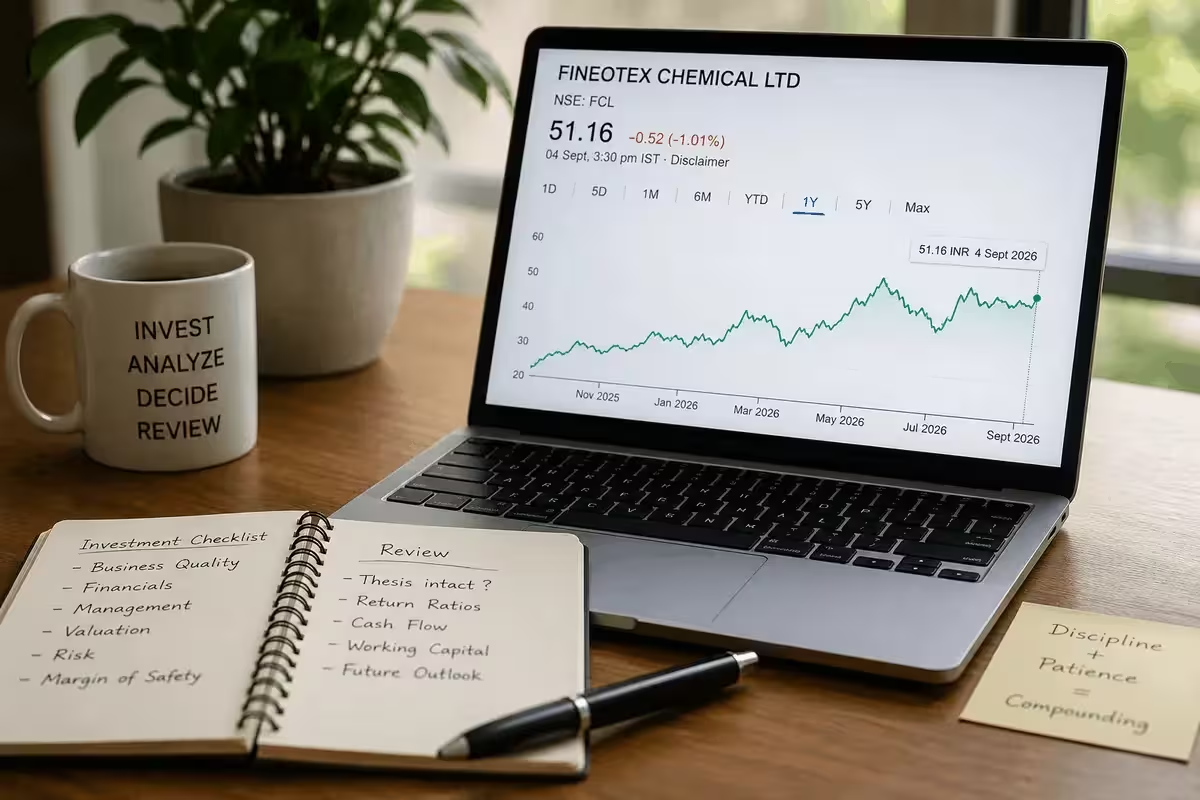
On 4 September 2026, I sold my entire holding in Fineotex Chemical Limited at a net realization of ₹51.18 per share after transaction costs. My effective acquisition cost was ₹25.85 per share, inclusive of all costs and adjusted for the subsequent corporate actions, including the bonus issue, but excluding the dividends.
The investment therefore generated an absolute return of approximately 98% before tax.
At first glance, selling a stock after it has nearly doubled may appear to be an obvious decision. It was not. I do not sell merely because a stock has risen, nor do I automatically sell because I have achieved a particular percentage return. The question that matters is whether the business I own today remains sufficiently attractive relative to the risks I see ahead and the alternatives available to me.
Fineotex Chemical was once a high-conviction investment for me. It had an attractive history of high return ratios, strong profitability, very little debt, and a business model that appeared relatively capital efficient. However, during my holding period, several things changed.
Some changes were visible in the financial ratios. Some were visible in the balance sheet and cash-flow statement. Others related to the direction of capital allocation, particularly the company’s increasing emphasis on acquisitions, diversification, and external fundraising.
None of the reasons discussed below necessarily mean that Fineotex will fail. The company may execute its strategy successfully. The CrudeChem acquisition may eventually create substantial shareholder value. The proposed fundraising may also prove beneficial.
But investing is not about proving whether management will succeed or fail. It is about assessing probabilities, risks, capital allocation, and the future economics of the business. As those factors changed, my original investment thesis weakened. I therefore decided to exit.
The Return Ratios Deteriorated Significantly
The first major reason for my exit was the deterioration in Fineotex’s return ratios.
When I started purchasing the shares in February 2025, the company’s financial profile was materially stronger than it is today. The screenshot below shows the ratios available at the time of beginning my purchase.
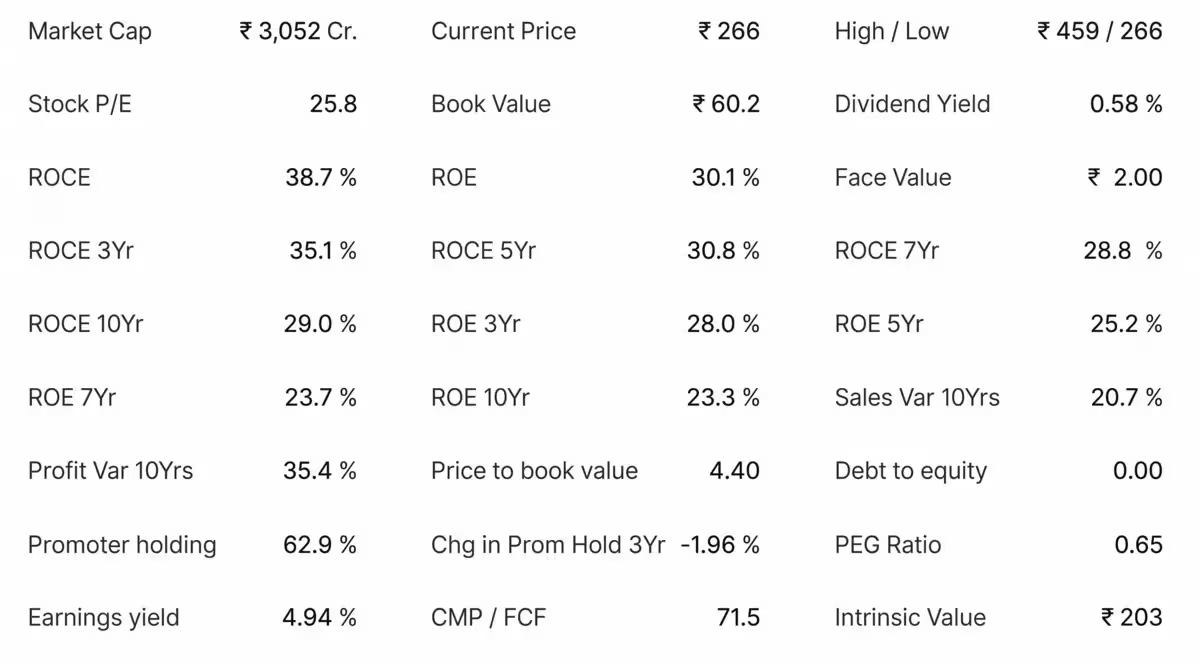
At that time, Fineotex had:
- ROCE of 38.7%
- ROE of 30.1%
- 3-year ROCE of 35.1%
- 5-year ROCE of 30.8%
- 10-year ROCE of 29.0%
- 3-year ROE of 28.0%
- 5-year ROE of 25.2%
- 10-year ROE of 23.3%
Those were the characteristics of a business I was comfortable owning. The company was generating high returns on both equity and capital employed.
At the time of my exit, the picture had changed materially.
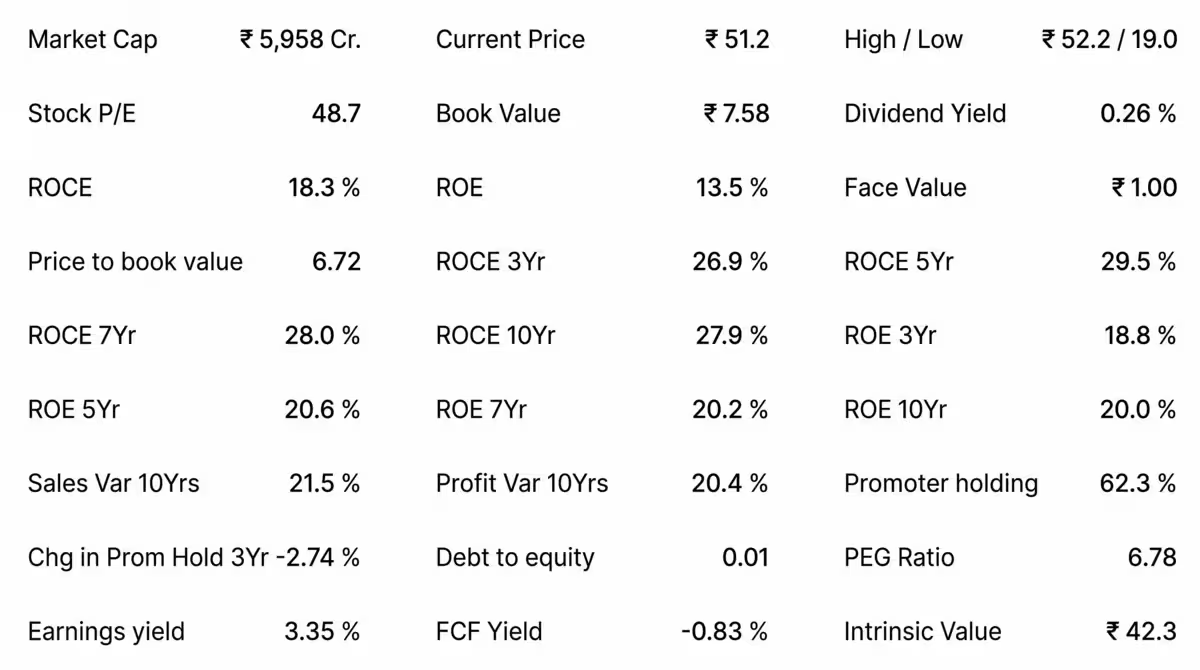
The latest ratios showed:
- ROCE of 18.3%
- ROE of 13.5%
- 3-year ROCE of 26.9%
- 3-year ROE of 18.8%
- 7-year ROCE of 28.0%
- 7-year ROE of 20.2%
- 10-year ROCE of 27.9%
- 10-year ROE of 20.0%
The decline in the current ratios is particularly significant. ROCE fell from 38.7% to 18.3%, while ROE fell from 30.1% to 13.5%.
A decline in return ratios does not automatically make a company unattractive. Sometimes return ratios decline temporarily because a company is investing for future growth. The problem arises when a business requires increasingly large amounts of capital to generate each additional rupee of profit.
That is precisely what began to concern me about Fineotex.
The Core Standalone Business Has Weakened
One of the most important developments that is easy to miss is the difference between Fineotex’s standalone and consolidated results.
The company’s consolidated financial performance improved sharply after the acquisition of CrudeChem. However, the standalone business, which represents the original Fineotex business, did not show the same strength.
For FY2025-26:
- Standalone revenue declined to approximately ₹396.88 crore from ₹439.22 crore in FY2024-25.
- Standalone PAT declined to approximately ₹91.89 crore from ₹97.23 crore.
- Consolidated revenue increased sharply to approximately ₹772.23 crore.
- Consolidated PAT increased to approximately ₹125.02 crore.
The contrast is important.
Consolidated growth was impressive, but a substantial part of it resulted from the inclusion of the newly acquired business. The underlying Fineotex business did not show comparable growth.
This changes the investment question. I was no longer evaluating primarily the same business that I had purchased in February 2025. I was increasingly evaluating a more complex group whose growth was being driven by acquisition and diversification.
The Proposed ₹800 Crore Fundraise Is Extremely Large Relative to the Company’s Net Worth
The agenda for Fineotex Chemical’s 23rd Annual General Meetingscheduled for 11 September 2026 includes an enabling proposal to raise up to ₹800 crore through equity shares and/or other eligible securities.
The important word here is enabling. The company has not necessarily raised ₹800 crore. Shareholders are being asked to approve the ability to raise capital up to that amount, potentially in one or more tranches and through specified mechanisms.
However, the size of the proposal caught my attention.
According to the FY2025-26 consolidated balance sheet, Fineotex’s shareholders’ funds were approximately ₹939.73 crore.
The proposed fundraising ceiling is ₹800 crore.
The calculation is simple:
₹800 crore ÷ ₹939.73 crore = 85.13%
In other words, the proposed fundraising ceiling is equivalent to approximately 85% of the company’s existing consolidated shareholders’ funds.
That is not a small fundraising proposal.
The company has indicated that the proceeds may be used for capital expenditure, working capital, general corporate purposes, and business expansion and diversification through inorganic growth opportunities.
This immediately raised several questions for me.
- Why does the company require such a large capital-raising authorization?
- How much of the capital, if raised, would be used for acquisitions?
- Would the new capital generate returns comparable to Fineotex’s historical return ratios?
- Would the proposed fundraising result in meaningful equity dilution for existing shareholders?
- If debt or debt-like instruments are used, would the additional borrowing materially increase the company’s financial risk and interest burden?
- Can management successfully deploy such a large amount of capital without reducing returns further?
Again, raising capital is not inherently negative. A wonderful business can create enormous value by raising capital and investing it at high rates of return.
But the opposite is also true. A mediocre business can destroy enormous amounts of shareholder wealth by raising capital and investing it at poor returns.
The Business Is Becoming More Capital Intensive
Fineotex historically appealed to me because of its high return ratios and relatively capital-efficient economics.
That profile now appears to be changing.
Growth increasingly appears to require:
- More working capital
- More inventory
- More receivables
- Capacity expansion
- Acquisitions
- Potentially substantial external capital
Warren Buffett has warned investors about a particular type of business that grows rapidly but requires substantial capital while producing inadequate economic returns. In his 2007 Berkshire Hathaway shareholder letter, he described this as the “worst sort of business”.
That quotation does not mean Fineotex is such a business. Fineotex remains profitable and has historically generated excellent returns.
But the direction of travel concerns me.
Return ratios are falling while the capital requirements of the business are increasing. That combination deserves close attention.
Increasing Reliance on Inorganic Growth and a More Complex Business Structure
Fineotex was historically known primarily for textile specialty chemicals, although its operations had expanded into other adjacent chemical categories.
I was originally positive about the company’s efforts to diversify beyond its traditional textile chemicals business. In fact, when I purchased Fineotex, I viewed diversification into other chemical segments and international expansion as potential sources of future growth.
My concern is therefore not diversification itself, nor is it simply that Fineotex acquired a company operating in a different market. What concerns me is that the company’s growth strategy is increasingly becoming acquisition-led, more capital-intensive and more complex.
The acquisition of a 53.33% controlling stake in CrudeChem Technologies (CCT), a U.S.-based specialty oilfield chemicals business, represents a significant transformation of Fineotex’s business. The company is now required to integrate and manage a business operating in a different geography and serving a different industry, with different customers, operating cycles, and economic characteristics.
The acquisition may ultimately succeed and create substantial value. Fineotex has discussed potential synergies, including opportunities to expand its product offerings and presence in North America. However, the transaction also introduces additional execution risk, complexity, and capital-allocation challenges.
In my view, the more important issue is the combination of factors that now exists: return ratios have deteriorated, working-capital requirements have increased, cash conversion has weakened, the standalone business has slowed, and future growth appears increasingly dependent on acquisitions and potentially substantial additional capital.
This changes the investment proposition. I was no longer evaluating primarily the same capital-efficient business that I originally purchased. I was increasingly evaluating a more complex group pursuing a growth strategy that may require significantly greater amounts of capital.
That is what led me to reassess my investment.
Inorganic Growth Can Create an Illusion of Strong Organic Progress
One danger in evaluating companies that grow through acquisitions is that consolidated revenue can grow much faster than the underlying economic performance of the original business.
Fineotex’s consolidated revenue increased sharply in FY2025-26, but its standalone revenue declined.
This distinction is important.
Acquiring another company can immediately increase revenue. That does not automatically mean shareholder value has been created.
For an acquisition to create value, the buyer must ultimately earn an attractive return on the capital committed to the transaction.
Growth through acquisition can therefore look impressive long before it is proven economically successful.
That is why I became uncomfortable with the possibility that Fineotex may continue to pursue inorganic growth while simultaneously requiring increasingly large amounts of shareholder capital.
Margins Have Come Under Pressure
The acquired CrudeChem business also appears to have a different profitability profile from Fineotex’s historical business.
Fineotex’s consolidated revenue expanded sharply after the acquisition, but profitability did not increase proportionately. The FY2025-26 numbers show that revenue growth was substantially stronger than PAT growth.
Margin dilution is not necessarily permanent. Management may improve procurement, scale operations, and realize the expected synergies.
However, until those improvements are demonstrated in the financial statements, investors should not automatically assume that larger revenue will translate into proportionately larger profits.
A larger company is not necessarily a better company.
What matters is whether the additional capital employed produces attractive incremental returns.
Goodwill Has Increased
The acquisition has also increased the amount of goodwill on the consolidated balance sheet.
Goodwill itself is not necessarily a problem. It simply represents, in broad terms, the premium paid above the identifiable net assets acquired.
But goodwill creates an additional risk.
If the acquired business fails to generate the expected economic benefits, the company may eventually be required to recognise an impairment.
In other words, an acquisition can increase reported assets and earnings initially while its long-term economic success remains uncertain.
The real test of the CrudeChem acquisition will therefore not be whether Fineotex’s consolidated revenue rises immediately. The real test will be whether the acquisition produces strong and sustainable returns on the capital committed to it.
Working Capital Efficiency Has Deteriorated Sharply
This was another major factor behind my decision to exit.
Fineotex’s consolidated working capital ratios deteriorated materially between FY2024-25 and FY2025-26.
| Ratio | FY2024-25 | FY2025-26 |
|---|---|---|
| Debtor Days | 79 | 137 |
| Inventory Days | 75 | Approximately 109–112 |
| Days Payable | 66 | Approximately 114–117 |
| Cash Conversion Cycle | 88 | 133 |
| Working Capital Days | 104 | Approximately 140–153 |
The exact figures can vary slightly depending on the calculation methodology, but the direction is unmistakable.
More cash is becoming tied up in the operating cycle.
Receivables and inventory have increased sharply, while the cash conversion cycle has lengthened.
When a company grows rapidly while working capital efficiency deteriorates, reported profit can look much healthier than actual cash generation.
That brings us to what I consider one of the most concerning developments.
Operating Cash Flow Turned Negative and Free Cash Flow Collapsed
In FY2024-25, Fineotex generated consolidated cash flow from operating activities of approximately ₹69.33 crore.
However, after capital expenditure of approximately ₹67.58 crore, free cash flow was only about ₹1.76 crore.
In FY2025-26, consolidated operating cash flow turned negative at approximately ₹23.81 crore. At the same time, the company spent approximately ₹150.68 crore on property, plant and equipment, and intangible assets.
As a result, free cash flow turned deeply negative at approximately ₹174.49 crore.
At the same time, the company reported consolidated profit after tax of approximately ₹125 crore.
This does not mean that the company’s accounting profit is incorrect. The difference is primarily explained by the substantial amount of cash absorbed by working capital, together with the significant increase in capital expenditure.
Nevertheless, it is a development that I cannot ignore.
Ultimately, shareholders cannot spend accounting profits. Businesses create lasting value through cash generation.
A temporary deterioration in cash flow is not necessarily a reason to sell. But when deeply negative free cash flow appears alongside falling return ratios, increasing working capital requirements and a proposal to raise up to ₹800 crore, the combination becomes more concerning.
The AGM agenda also includes a proposal relating to material related-party transactions between Fineotex Biotex HealthGuard FZE and CrudeChem Technology LLC.
The aggregate proposed limit is up to ₹500 crore for FY2026-27, including limits for transactions involving goods or services and loans or advances.
I am not suggesting that there is anything improper about these proposed transactions. Related-party transactions are not inherently negative, and companies often need them to operate efficiently within international corporate structures.
However, the size of the proposed limits matters.
It means that Fineotex is becoming a significantly more complicated corporate group, with more capital moving between subsidiaries and more dependence on management’s capital-allocation decisions.
As an investor, I generally prefer simpler businesses where capital allocation is easier to understand and monitor—businesses with one-foot bars that I can step over.
Warren Buffett’s Warnings About Acquisitions
Warren Buffett has repeatedly warned investors about the risks associated with corporate acquisitions.
His concern is not that all acquisitions are bad. Berkshire Hathaway itself was built through numerous acquisitions.
The concern is whether the acquiring company gives up more value than it receives.
In Berkshire Hathaway’s 1982 shareholder letter, Buffett observed that, in many acquisitions, “the thrill of the chase blinded the pursuers to the consequences of the catch.”
The message is simple. Management can become focused on completing an acquisition rather than on determining whether the economics of the acquisition are attractive.
In his 1994 shareholder letter, Buffett described the incentives behind many large acquisitions and wrote that they “usually reduce the wealth of the acquirer’s shareholders”.
Again, this does not mean that Fineotex’s acquisition will fail. The CrudeChem acquisition may eventually become highly successful.
But acquisitions should be judged with scepticism until their economic benefits are demonstrated.
A company can grow revenue while destroying shareholder value.
A company can double its size while reducing returns on capital.
A company can make successful acquisitions from an accounting perspective while overpaying economically for the businesses it acquires.
For me, the most important question is not:
“How fast can Fineotex grow?”
The more important question is:
“At what return on capital can Fineotex grow?”
If Fineotex raises substantial capital, makes additional acquisitions and successfully maintains high incremental returns, the company may create enormous value.
If, however, each additional phase of growth requires more capital while producing lower returns, shareholders may eventually discover that revenue growth was not equivalent to value creation.
The Valuation Did Not Provide Much Margin for Error
At the time of my exit, Fineotex was also trading at a valuation that assumed a substantial degree of future success.
Based on the prevailing market data, the stock was trading at a relatively high price-to-earnings multiple and a substantial premium to book value.
Such valuations can be justified when a company consistently delivers high growth, high returns on capital, and strong cash generation.
But when return ratios deteriorate, cash flow weakens and capital requirements rise, the valuation becomes less forgiving.
I was therefore no longer willing to own the stock at that valuation while simultaneously assuming successful integration of CrudeChem, future improvement in margins, restoration of working capital efficiency, and effective deployment of potentially hundreds of crores of new capital.
Why I Did Not Wait for the Turnaround
I could have waited.
I could have waited for the working capital cycle to improve.
I could have waited for CrudeChem’s margins to improve.
I could have waited to see how management deploys the proposed fundraising authority.
But investing is not a game in which I need to wait for every uncertainty to be resolved.
I originally invested in Fineotex because of a particular combination of high returns on capital, strong profitability, relatively efficient operations, and an attractive business model.
That combination has changed.
The company may be entering a new and more ambitious phase. But that new phase requires me to make a new set of assumptions about management’s ability to execute acquisitions, integrate businesses, manage working capital, and deploy much larger amounts of capital.
I decided that I did not have enough conviction to make those assumptions.
The Most Important Lesson: I Bought a Business, Not a Ticker
One of the dangers in investing is becoming attached to a company simply because it has been profitable for us.
A successful investment can become a reason to ignore a changing investment thesis.
I believe investors should regularly ask:
- Is this still the same business I originally invested in?
- Are the economics improving or deteriorating?
- Are returns on capital increasing or declining?
- Is cash generation keeping pace with accounting profits?
- Is growth becoming more capital intensive?
- Is management allocating capital in a way that I understand?
- If I did not already own this stock, would I buy it today?
That last question is particularly important.
If I would not buy Fineotex today at the current price, knowing everything I know about the changing business, I should ask why I continue to hold it.
Conclusion: Why I Sold Fineotex Chemical
I sold Fineotex Chemical because the investment thesis that originally led me to buy the company had changed materially.
My decision to sell does not mean that my original decision to buy the company was wrong. I had explained my original investment thesis in detail in my earlier article, Deep Dive: Why I Aggressively Bought Fineotex Chemical Ltd Share.
At the time of purchase, Fineotex had several characteristics that I considered highly attractive: exceptionally strong return ratios, a debt-free balance sheet, a strong history of sales and profit growth, an attractive valuation, and what I believed was significant potential for further expansion.
I was also positive about the company’s diversification strategy and its efforts to expand beyond its traditional textile chemicals business. My original investment thesis did not assume that Fineotex would remain permanently dependent on textile chemicals. On the contrary, I saw diversification as a potential source of future growth.
The investment worked financially. My effective acquisition cost was ₹25.85 per share, inclusive of all costs and adjusted for the subsequent bonus issue. I sold my entire holding at a net realization of ₹51.18 per share after transaction costs. This represented an absolute return of approximately 98% before tax.
However, a profitable investment can still become less attractive over time. The fact that I made money on Fineotex does not mean that I should ignore changes in the underlying business.
Investing requires us to continually test our assumptions against new information.
Between my purchase and my exit, several developments changed my assessment of Fineotex:
- Current ROCE declined from 38.7% to 18.3%.
- Current ROE declined from 30.1% to 13.5%.
- The standalone business weakened, with revenue and profit declining in FY2025-26.
- Working-capital efficiency deteriorated materially.
- Debtor days and inventory days increased sharply.
- The cash conversion cycle lengthened significantly.
- Consolidated operating cash flow turned negative in FY2025-26 despite the company reporting a substantial accounting profit.
- The business became more capital intensive.
- Consolidated margins came under pressure following the acquisition.
- The company’s growth increasingly became dependent on inorganic expansion.
- The acquisition of CrudeChem added a completely new business segment and increased the complexity of the group.
- The proposed authority to raise up to ₹800 crore introduced the possibility of substantial additional capital deployment and potential shareholder dilution.
- Goodwill increased following the acquisition, creating an additional risk if the expected economic benefits fail to materialise.
- The group structure and related-party transactions became more complex.
For me, the most important issue was not simply that Fineotex had diversified or acquired a company in a new sector.
I originally supported diversification, and I was initially positive about the company’s move into new chemical segments and the potential benefits of the CrudeChem acquisition.
What changed was the overall combination of factors.
Fineotex’s return ratios deteriorated. Its working-capital requirements increased. Cash conversion weakened. The standalone business slowed. The group became more complex. Growth increasingly appeared to require acquisitions and additional capital.
The concern, therefore, was not diversification itself. The concern was that Fineotex’s growth strategy was becoming increasingly acquisition-led, capital-intensive, and complex at precisely the time its return ratios and cash conversion had weakened.
That distinction is important.
Growth does not automatically create shareholder value. A company can increase revenue through acquisitions while reducing returns on capital. A company can become larger while becoming less capital efficient. A company can raise substantial amounts of new capital and still fail to generate attractive returns on that capital.
Ultimately, the question I asked myself was not:
“Can Fineotex continue to grow?”
The more important question was:
“At what rate of return can Fineotex grow, and how much capital will be required to generate that growth?”
Fineotex may successfully integrate CrudeChem. The acquired business may become more profitable. Working-capital efficiency may improve. Margins may recover. Future acquisitions may generate attractive returns. The proposed fundraising, if and when undertaken, may also be deployed successfully.
All of those possibilities remain open.
But my responsibility as an investor is not to prove that a company will fail before selling it. Nor is it to hold a stock indefinitely merely because my original analysis was correct and the investment has produced a profit.
My responsibility is to continually assess whether the business I own today still justifies my capital based on the information available today.
By the time I sold Fineotex, I no longer had sufficient conviction to make the assumptions required for the company’s next phase of growth. I was being asked, in effect, to place greater faith in successful acquisition execution, the integration of a new foreign business, a recovery in return ratios, an improvement in cash conversion, and the effective deployment of potentially substantial additional capital.
I decided that I was no longer comfortable making those assumptions.
That is why I sold Fineotex Chemical at a net price of ₹51.18 per share.
These two articles should therefore be read together. My earlier article explains why I bought Fineotex Chemical. This article explains why I later changed my mind and sold it.
I believe this is an important principle of investing: changing your mind when the facts change is not inconsistency. Refusing to re-examine an investment simply because we publicly supported it in the past can be far more dangerous.
The sale should not be judged solely by what Fineotex’s share price does afterwards. A good investment decision can occasionally produce a poor outcome, and a poor investment decision can occasionally produce a good outcome.
What matters is whether the decision was rational based on the information available at the time.
That is the standard I applied when I bought Fineotex Chemical. It is also the standard I applied when I decided to sell it.
Read The Disclosure:
Sold Completely. Exited.
I sold my entire holding in Fineotex Chemical Limited on 4 September 2026. I have no position in the company at the time of publishing this article.
This article reflects my personal investment decision and the reasoning behind it. It is not investment advice or a recommendation to buy or sell Fineotex Chemical Limited. Readers should conduct their own research and consider their individual financial circumstances before making investment decisions.
Financial figures and corporate actions discussed in this article are based on the company’s FY2025-26 financial disclosures, the notice for its 23rd Annual General Meeting, the company’s investor disclosures and financial data available at the time of writing.
Did You Read The Disclaimer?
Not a SEBI-Registered Research Analyst or Investment Adviser
I am not a SEBI-registered Research Analyst or Investment Adviser. Raj & Co is an independent educational and informational website. All articles, views, opinions, observations, analyses and other content published on this website are provided solely for general informational and educational purposes.
Nothing published on this website constitutes investment advice, financial advice, research advice, a research report, a recommendation, solicitation, offer, endorsement or invitation to buy, sell, subscribe to, hold or otherwise deal in any security, financial product or investment strategy. The content is not tailored to any individual’s financial circumstances, investment objectives, risk tolerance or other personal circumstances.
Any discussion of a company, security, market, investment strategy, price, valuation, historical performance or other investment-related matter is intended solely for educational discussion and should not be interpreted as a recommendation or prediction of future performance. References to particular securities or investments do not constitute recommendations to buy, sell, or hold them.
I may personally buy, sell, hold or change my views or positions in securities at any time. Such personal transactions or changes in views do not constitute recommendations to readers. Where I disclose such positions or changes, the disclosure may occur after a transaction has been executed and may not be immediate.
Investment in the securities market is subject to market risks. Past performance is not indicative of future results. Readers should conduct their own independent research and due diligence and consider their own financial circumstances, investment objectives and risk tolerance before making any investment decision. If personalized financial advice is required, consult a financial adviser or other professional appropriately registered with SEBI.
No representation or warranty is made regarding the accuracy, completeness, timeliness or reliability of any information published on this website, and no responsibility is accepted for any loss arising from reliance upon such information to the extent permitted by applicable law.
SEBI’s investor education initiatives emphasize informed investing, financial literacy, risk awareness, and disciplined long-term wealth creation.
E & O E.
It spiked since the time you sold.
Coincidentally, as a part of the additional surveillance mechanism (ASM), NSE changed the circuit filter from 5% to 10% after the trading hours on Friday, September 4, 2026. Market is celebrating that.
As a matter of fact, you cannot catch either the top or the bottom exactly in the stock markets. Just do what you think is the best for you at any point in time, and don’t turn back.
Hence no regrets. Just move on looking forward to another opportunity.
In investing, the rearview mirror is always clearer than the windshield.
What factors intrigued you in CrudeChem acquisition?
The pre-acquisition revenues of CrudeChem Technology LLC, FrackMex Equipment and Services LLC, Lonestar Technoboost LLC, and Oil Pro Advantage INC taken together was ~$67.86m. (Although Fineotex subsequently disclosed the group FY25 revenue as $67.4 million, while ICRA described the four entities as generating approximately $65 million.)
Fineotex management disclosed the CCT group as having approximately $4.0–4.5 million EBITDA on the pre-acquisition business.
Therefore EBITDA margin = $4.0–4.5m ÷ ~$67.5m = ~5.9%–6.7%
So roughly 6–7% EBITDA margin.
The problem is Fineotex bought a low-margin, relatively capital-intensive, cyclical oilfield-chemical business and then committed substantially more capital to expanding it. That’s a different risk.
Simply buying revenue at low or negative returns. Otherwise, a business that doubles its revenue while earning poor returns on the additional capital may be far less attractive than a smaller company that grows steadily while generating excellent returns on capital.
Hi Raj — I read your Fineotex exit post, and what stuck with me wasn’t the +98% — it was that you sold anyway when ROCE fell from 38.7% to 18.3% and the growth turned out to be acquisition-driven rather than standalone. Most write-ups celebrate the gain and stop there; you published the exact numbers that broke the thesis, and paired it with the original buy case from Feb 2025. That’s the kind of record-keeping I wish more research did.
I’m building a daily stock-research workflow called AlphaSignal that tries to do the same thing at scale: each call carries its evidence, and every call gets graded afterward against the market over a declared horizon, win or lose. A sample mail and the full public scorecard (449 graded calls, about 42% beating the market so far, with the misses shown, not hidden) are both available, and I can share them if you’d like to take a look.
I’m not selling anything and this isn’t investment advice — I’m just asking for feedback and gathering thoughts on whether the workflow would actually help. For someone who tracks a thesis the way you do: does a system that grades itself publicly, including the losers, earn your trust more than one that only shows winners — or is the grading itself not the part you’d use? Any blunt feedback welcome.
Sounds good, like what I would like to hear, a honest stance and disclosure, whether right or wrong, hit or miss. Message me at x.com/Rajasekharan for my mail ID.