How Retained Profits Beat High Dividend Yields in Wealth Creation?
Many investors love receiving regular dividend payouts from their favorite stocks. These cash payments often feel like a steady reward or a gift for being a loyal shareholder. However, a closer look at the math reveals a significant hidden leak in your returns. To be honest, this dream of passive income actually slows down your long-term wealth creation. What feels like a “gift” is often a major tax friction in disguise. To build true long-term wealth, you must understand the superior efficiency of retained profits.
Every rupee paid out as a dividend must first survive a heavy gauntlet of taxes. First, the company pays its own corporate tax on the earned profit. Afterward, you pay a steep personal tax on that same profit once it hits your bank account. Double taxation by the government on the same profit. Therefore, after taxing twice, the actual amount you receive is much smaller than the original profit earned. This friction acts as a massive drag on the compounding process.
Instead of taking the cash, shareholders often benefit more when companies keep the money. If a business reinvests wisely, it avoids the immediate tax hit at the shareholder level. Moreover, that retained capital can fund new projects or expand existing operations. This strategy allows your investment to grow without the government taking a large slice every year.
Eventually, the goal of investing is to maximize the final value of your portfolio. Furthermore, choosing growth over immediate cash is often the most tax-efficient path for Indian domestic company investors. Understanding this dynamic is the first step toward better capital allocation.
Corporate Income Tax in India: Impact on Domestic Companies
Indian domestic companies face a complex tax landscape today. Currently, the corporate tax rate typically ranges between 15% and 30%. However, these base rates do not represent the final tax bill. Companies must also pay a mandatory surcharge based on their total income levels. Additionally, a 4% Health and Education Cess applies to the total tax and surcharge amount.
Consequently, the effective tax rate often ends up higher than the base percentage. For instance, newer manufacturing firms might enjoy the lower 15% base rate. Meanwhile, established firms often fall into the 25% or 30% brackets. Therefore, a large portion of every rupee earned goes directly to the government. This initial deduction significantly reduces the pool of capital available for distribution or growth.
Actually, the Income Tax Department of India provides specific slabs for these calculations. Understanding these figures is vital for any serious fundamental analyst. High tax outflows limit the internal cash flow of a business. Furthermore, this is only the first layer of the total tax burden.
Business owners must navigate these rules to maintain healthy balance sheets. Meanwhile, investors should track how these taxes impact the bottom line of their holdings. A company with high tax efficiency often has more room to maneuver. Nevertheless, the corporate tax is just the beginning of the journey for a profit.
The Double Taxation Trap: From Corporate Profits to Dividends
Double taxation represents a major hurdle for individual investors in India. As previously mentioned, the company first pays tax on its annual profits. However, the tax journey does not end at the corporate level. When the firm distributes the remaining profit as a dividend, you face another charge. This second layer of taxation is often surprisingly steep for high earners.
Specifically, the government treats dividend income as part of your regular taxable income. Many investors now find themselves in the highest tax bracket of 30%. Furthermore, a massive surcharge of 0 to 25% applies to this specific tax amount. Finally, you must add a 4% Health and Education Cess to the total. Consequently, the effective tax rate on your dividends can exceed 38%.
This structure means the government takes a slice from the same profit twice. First, it takes a portion from the company. Later, it takes a significantly larger portion from your personal payout. Therefore, the “net” dividend reaching your pocket is heavily ripped by the time it survives both tax layers. This friction makes dividends an expensive and inefficient way to receive investment returns.
Actually, this policy changed a few years ago when the Dividend Distribution Tax was abolished. Now, the burden sits directly on the shoulders of the individual shareholder. Consequently, high-net-worth individuals lose a vast portion of their yields to these combined taxes. Understanding this trap is essential for efficient wealth management.
The 42-Paise Reality: The Cost of a Rupee in Dividends
To understand the true cost of dividends, we must trace a single rupee of profit from the company’s books to your bank account. If a domestic company earns ₹1.00 in profit and chooses to distribute it fully, the tax man takes the first bite. At the highest corporate tax rate of 34.94% (including surcharge and cess), the company is left with only ₹0.65 to send your way.
Actually, the “leakage” does not stop there. Once that remaining ₹0.65 hits your account as a dividend, it is taxed again at your personal income tax slab. For a high-net-worth individual, this second tax layer (capped at an effective 35.88%) strips away another ₹0.23. Consequently, for every ₹1.00 of profit earned, you are left with just ₹0.417—or roughly 42 paise. The government effectively takes away nearly 58% of the profits earned. By contrast, focusing on retained profits keeps that first rupee whole, allowing the full post-corporate-tax amount to compound within the business.
Dividend Payouts vs. Retained Earnings: The Tax Efficiency Gap
There is a massive gap in efficiency between paying dividends and retaining earnings. When a company pays a dividend, the tax leakage is immediate and permanent. As we saw, nearly half the original profit can vanish into taxes. Conversely, retained earnings stay within the corporate structure. This money remains untouched by the second layer of personal income tax.
Therefore, the company has more capital to work with than the individual shareholder would. If you receive 60 rupees after tax, you can only reinvest that smaller amount. However, if the company keeps 100 rupees, the full amount continues to work. Consequently, the business operates with a much larger capital base. This disparity creates a significant advantage for companies that do not over-distribute cash.
Furthermore, investors do not have to pay tax on these internal funds. The tax liability is essentially deferred indefinitely. Meanwhile, the value of your shares should rise as the company grows. This growth eventually leads to capital gains rather than dividend income. Typically, the long-term capital gains (LTCG) tax rates at 12.5% are much lower than the 30% plus surcharge on dividends.
Actually, savvy investors look for high Return on Capital Employed (ROCE) in such firms. A high ROCE ensures that the retained cash is generating excellent value. Otherwise, keeping the cash would be a waste of resources. Therefore, the tax efficiency gap only benefits you if the management is competent.
Maximizing Your Money: The Compounding Power of Retained Cash
Compounding works best when you leave the principal amount untouched for long periods. However, taxes act as a recurring haircut that stunts this exponential growth. When companies pay dividends, the compounding chain breaks every single year. Actually, this annual leak results in a massive loss of potential wealth over time. Consequently, you reinvest a much smaller net amount back into the market.
The mathematical difference between these two paths is staggering at higher growth rates. For instance, many Indian companies have achieved strong double-digit growth recently. A company growing at 12% without dividend leakage creates life-changing wealth for its owners. Furthermore, this is because the tax-saved portion also earns a return in following years. Therefore, you are essentially earning interest on money that would have gone to taxes.
This bonus return adds up to a fortune over a long investment horizon. The table below illustrates this effect clearly with a 12% annual growth rate. In the dividend scenario, we assume a total tax hit of nearly 38% on payouts.
| Year | Retained Growth (Net Sum) | Dividend Path (Net Sum) |
| 1 | ₹1,12,000 | ₹1,07,440 |
| 5 | ₹1,76,234 | ₹1,43,163 |
| 10 | ₹3,10,585 | ₹2,04,956 |
| 15 | ₹5,47,357 | ₹2,93,420 |
| 20 | ₹9,64,629 | ₹4,20,068 |
As shown above, the retained growth path results in vastly higher terminal wealth. Specifically, the gap grows wider as time progresses for the investor. Therefore, you end up with over ₹5.4 lakh more by avoiding the dividend tax trap. This difference represents pure efficiency gained through wise capital allocation by management. Eventually, the share price reflects this accumulated internal value without the annual tax drain.
This compounding effect is exactly why legendary investors prioritize internal growth over payouts. As Warren Buffett famously explained in his letters to Berkshire Hathaway shareholders:
In economic terms, the [deferred tax] liability resembles an interest-free loan from the U.S. Treasury.
He elaborated on this “hidden leverage” by noting:
Deferred tax liabilities bear no interest… In effect, they give us the benefit of debt – an ability to have more assets working for us – but saddle us with none of its drawbacks.
By focusing on companies that reinvest, you are essentially accepting this interest-free loan from the government. Instead of having your capital ripped away as taxes, you keep it inside the business where it can generate more profit, year after year.
Strategic reinvestment acts as a powerful engine for increasing share prices over time. When a company keeps its profits, it can fund growth without taking on expensive debt. Consequently, the business avoids high interest payments that would otherwise eat into future earnings. This internal funding makes the company more resilient during tough economic cycles. Furthermore, it allows management to pounce on new market opportunities quickly.
Actually, using retained earnings is often the cheapest form of capital for a business. Instead of asking banks for loans, the company uses its own “tax-saved” cash. Therefore, every rupee reinvested has a higher potential to create value than a borrowed rupee. This efficiency eventually reflects in the stock price as the company’s intrinsic value rises. Investors benefit from this appreciation without the friction of annual tax payments.
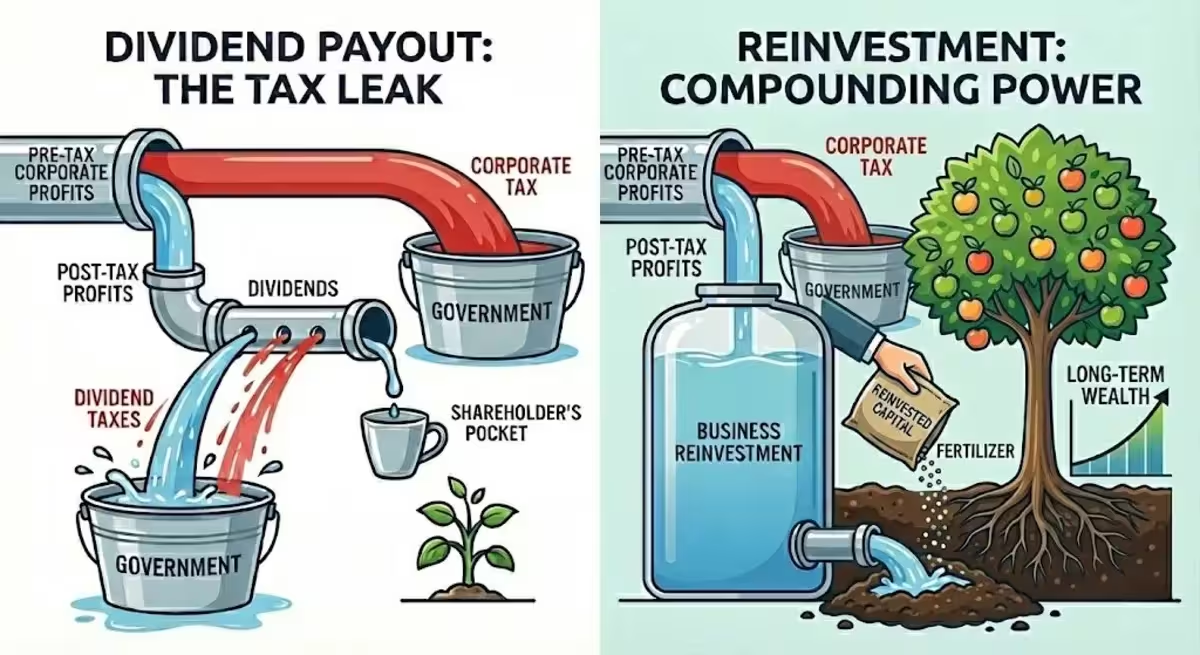
Moreover, wise reinvestment can lead to an expanding competitive moat. Companies can spend on research, development, or better infrastructure. These investments often lead to higher profit margins in the long run. Consequently, the business becomes more dominant in its industry. As a result, the shareholder owns a piece of a much larger and stronger entity.
Eventually, the market rewards this growth with a higher valuation multiple. Meanwhile, the shareholder enjoys the “quiet” compounding of their wealth. This process is much more effective than receiving small, heavily taxed cash increments. Therefore, a focus on reinvestment is a focus on long-term prosperity.
Maximizing Your Money: The Compounding Power of Retained Cash
Compounding works best when you leave the principal amount untouched for long periods. However, taxes act as a recurring “haircut” that stunts this exponential growth. When dividends are paid, the compounding chain is broken every single year. Consequently, you are left reinvesting a much smaller “net” amount back into the market. Over a decade, this small annual leak results in a massive loss of potential wealth.
Actually, Einstein famously called compounding the eighth wonder of the world. Therefore, you should protect the compounding process from unnecessary tax friction at all costs. If a company retains its profit, 100% of that capital continues to compound internally. Meanwhile, the shareholder pays zero tax as the company’s book value increases. This allows the power of compounding to work on the gross profit, not the post-tax remainder.
Furthermore, the mathematical difference between these two paths is staggering over time. A company growing at 15% without dividend leakage creates far more wealth than one paying high yields. This is because the “tax-saved” portion also earns a return in the following years. Therefore, you are essentially earning interest on money that would have otherwise gone to the government. This “bonus” return adds up to a fortune over a long investment horizon.
Eventually, the share price will reflect this accumulated internal value. Investors can then choose when to realize their gains and pay taxes. Consequently, you maintain control over the timing of your tax liability. This control is a vital tool for any sophisticated investor in the Indian market.
Choosing reinvestment over dividends significantly lowers your overall tax burden. As discussed, dividends are taxed at your slab rate plus a heavy surcharge. Conversely, capital gains on shares held for over a year face a much lower tax rate. Currently, Long-Term Capital Gains (LTCG) in India are taxed at only 12.5% for gains above a certain limit. Therefore, you keep a much larger portion of the growth when you finally sell your shares.
Actually, the difference between a 38% tax rate and a 12.5% rate is enormous. This gap allows your capital to grow much faster within the company. Furthermore, you only pay this tax when you decide to sell the investment. This means you can stay invested for decades while avoiding annual tax payments. Consequently, the government essentially provides you with an interest-free loan on the deferred tax amount.
Moreover, the tax on capital gains is only triggered by your personal action. Meanwhile, dividend taxes are forced upon you whenever the company decides to pay out. This lack of control can disrupt your long-term financial planning and tax strategy. Therefore, companies that prioritize reinvestment give you more flexibility as an owner. You can choose to harvest gains during years when your other income is lower.
Eventually, the goal is to minimize the “friction” that slows down your wealth building. By avoiding dividends, you bypass the most expensive tax category in the Indian system. This simple shift in focus can add years of growth to your portfolio. It turns a high-tax liability into a low-tax asset over the long term.
Analyzing Wise Capital Allocation for Long-Term Value Growth
However, retaining earnings is only beneficial if management uses the cash wisely. Investors must evaluate the efficiency of this capital allocation regularly. Specifically, you should look for a consistently high Return on Equity (ROE). A high ROE suggests that the company generates strong profits from its retained wealth.
Conversely, a low ROE might mean the company is wasting your money. Management should only keep cash if they can earn more than the market average. Otherwise, they should return the capital to the shareholders despite the tax hit. Therefore, the quality of the leadership team is a critical factor for your success.
You can find detailed financial metrics on sites like Screener.in to aid your research. Furthermore, check if the company is investing in projects with a high net present value. Wise allocation turns retained profits into a powerful compounding machine. In contrast, poor allocation traps your capital in unproductive assets.
Consequently, you must monitor annual reports for clear signs of growth-oriented spending. The goal is to see a direct link between retained cash and future earnings growth. Ultimately, you are trusting the company to be a better steward of your capital than yourself.
The 10.76% Floor: Understanding Your Real Cost of Capital
Inflation acts as a silent killer of wealth, especially when it sits at 7%. Therefore, your business must earn enough to cover both taxes and rising costs. To have any real profit left for reinvestment, the company needs a very strong pre-tax performance. Specifically, a firm facing the maximum tax rate must clear a high initial bar.
Actually, we can calculate the pre-tax return needed just to keep the purchasing power of your money. Using the maximum effective tax rate of 34.94%, the formula for this “floor” is simple. You divide the inflation rate by the portion of profit the company actually keeps. Consequently, the math for a 7% inflation rate looks like this:
Pre-Tax Hurdle = Inflation Rate / (1 – Effective Tax Rate)
Therefore, Pre-Tax Hurdle = 7% / (1 – 0.35) = 10.76%
Therefore, a nominal ROE of 10.76% is the absolute minimum for any quality business. Furthermore, this means an ROE of 10.76% results in a 0% real return for the shareholder. Any company earning less than this is effectively destroying the value of your capital. Understanding this benchmark is the first step toward professional-grade fundamental analysis.
Eventually, investors must demand returns well above this 10.76% floor. This spread is where true wealth creation begins for the long-term owner. Meanwhile, companies that struggle to clear this hurdle often see their share prices languish. Therefore, always check if the management is actually beating the cost of capital. This mathematical floor is one of the primary reasons behind the sectors and industries I avoid, as many legacy businesses cannot sustain the necessary return ratios.
The 20% ROE Rule: Targeting High-Performance Business Growth
To achieve meaningful growth, you must look beyond the break-even point. Actually, setting a personal cost of capital at 12% provides a necessary safety margin. To reach this 12% post-tax growth target, a company needs exceptional internal efficiency. Specifically, you should seek businesses with an ROE of 19% to 20% or higher.
This higher ROE target ensures the company can pay the maximum tax and still grow. As we calculated, a 12% net growth rate requires an 18.44% pre-tax ROE. Therefore, a 20% ROE provides a buffer for unexpected costs or economic shifts. Consequently, these companies can reinvest aggressively while maintaining a very healthy balance sheet.
Furthermore, a 20% ROE allows the company to fund its own expansion without dilution. You do not need the business to take on risky debt when internal returns are high. This self-sustaining nature is what makes high-ROE companies so attractive in the secondary market. They become compounding machines that work quietly for the benefit of the shareholder, without diluting the shareholder equity either.
Moreover, consistent double-digit growth paired with high ROE is a rare combination. When you find such a business, the tax-efficient reinvestment strategy becomes even more powerful. Eventually, the market rewards this superior capital allocation with significant price appreciation. Therefore, sticking to the 20% ROE rule is your best defense against tax and inflation. To see how this ROE requirement fits into a broader evaluation, you can refer to my stock-investing checklist of essential metrics.
Conclusion: Choosing Compounding Over Immediate Dividend Payouts
In conclusion, the Indian tax structure makes high dividend payouts a costly choice for most. The reality of double taxation significantly erodes your potential returns over the long term. Consequently, savvy investors should prioritize companies that reinvest their profits into high-growth opportunities. This approach allows your capital to compound without the constant drag of heavy personal taxes.
Furthermore, you gain more control over your tax liability by focusing on capital appreciation. You can choose when to realize gains and benefit from much lower tax rates. Therefore, the strategy of retaining earnings aligns perfectly with the principles of efficient wealth creation. It transforms a simple investment into a powerful, self-sustaining engine of growth.
Actually, the goal of any investment is to achieve the highest possible net value. By minimizing tax friction, you ensure that more of your money stays working for you. Meanwhile, you must remain vigilant about the quality of the business, the quality of the company management and their allocation choices. Only then can you be sure that your retained earnings are building real, long-term value.
Ultimately, choosing compounding over immediate cash is a mark of a disciplined investor. It requires patience and a clear understanding of the mathematical advantages involved. However, the rewards for this discipline are often life-changing in the Indian market context. Therefore, look for businesses that value growth and tax efficiency as much as you do.
Did You Read The Disclaimer?
Not a SEBI-Registered Research Analyst or Investment Adviser
I am not a SEBI-registered Research Analyst or Investment Adviser. Raj & Co is an independent educational and informational website. All articles, views, opinions, observations, analyses and other content published on this website are provided solely for general informational and educational purposes.
Nothing published on this website constitutes investment advice, financial advice, research advice, a research report, a recommendation, solicitation, offer, endorsement or invitation to buy, sell, subscribe to, hold or otherwise deal in any security, financial product or investment strategy. The content is not tailored to any individual’s financial circumstances, investment objectives, risk tolerance or other personal circumstances.
Any discussion of a company, security, market, investment strategy, price, valuation, historical performance or other investment-related matter is intended solely for educational discussion and should not be interpreted as a recommendation or prediction of future performance. References to particular securities or investments do not constitute recommendations to buy, sell, or hold them.
I may personally buy, sell, hold or change my views or positions in securities at any time. Such personal transactions or changes in views do not constitute recommendations to readers. Where I disclose such positions or changes, the disclosure may occur after a transaction has been executed and may not be immediate.
Investment in the securities market is subject to market risks. Past performance is not indicative of future results. Readers should conduct their own independent research and due diligence and consider their own financial circumstances, investment objectives and risk tolerance before making any investment decision. If personalized financial advice is required, consult a financial adviser or other professional appropriately registered with SEBI.
No representation or warranty is made regarding the accuracy, completeness, timeliness or reliability of any information published on this website, and no responsibility is accepted for any loss arising from reliance upon such information to the extent permitted by applicable law.
SEBI’s investor education initiatives emphasize informed investing, financial literacy, risk awareness, and disciplined long-term wealth creation.
E & O E.
Good post , unable to contact you , kindly reply to my mail , . I have queries regarding medical dictionary
Sorry. I didn’t get your mail.
I don’t update the medical spell checker nowadays.
For anything else, you may reach me through the contact page.