Why Gold Is Not an Ideal Investment Choice for a Value Investor?
Gold as an Investment for a Value Investor
Gold has had an extraordinary run since I first wrote this article in 2011. Back then, the question was whether gold’s rapid rise was sustainable. Today, that question looks very different. Gold has demonstrated that an asset can remain expensive for far longer than many investors expect—and can continue rising to levels that seemed unimaginable years earlier.
That experience changes the argument, but not the underlying distinction between owning gold and owning a productive business.
Gold can have a legitimate place in a portfolio. It can diversify risk, provide liquidity during periods of financial stress, and protect purchasing power over long periods. Central banks have also continued accumulating gold, while investment demand has become an important source of demand. In 2025, global gold investment demand reached a record 2,175 tonnes, while central banks added another 863 tonnes to their reserves.
But those facts do not necessarily make gold an ideal investment for a value investor whose objective is to buy productive assets at sensible prices and allow those assets to compound capital over many years. My investment principles for preserving and growing capital explain why productive businesses, sensible valuations, and long-term compounding are central to this approach.
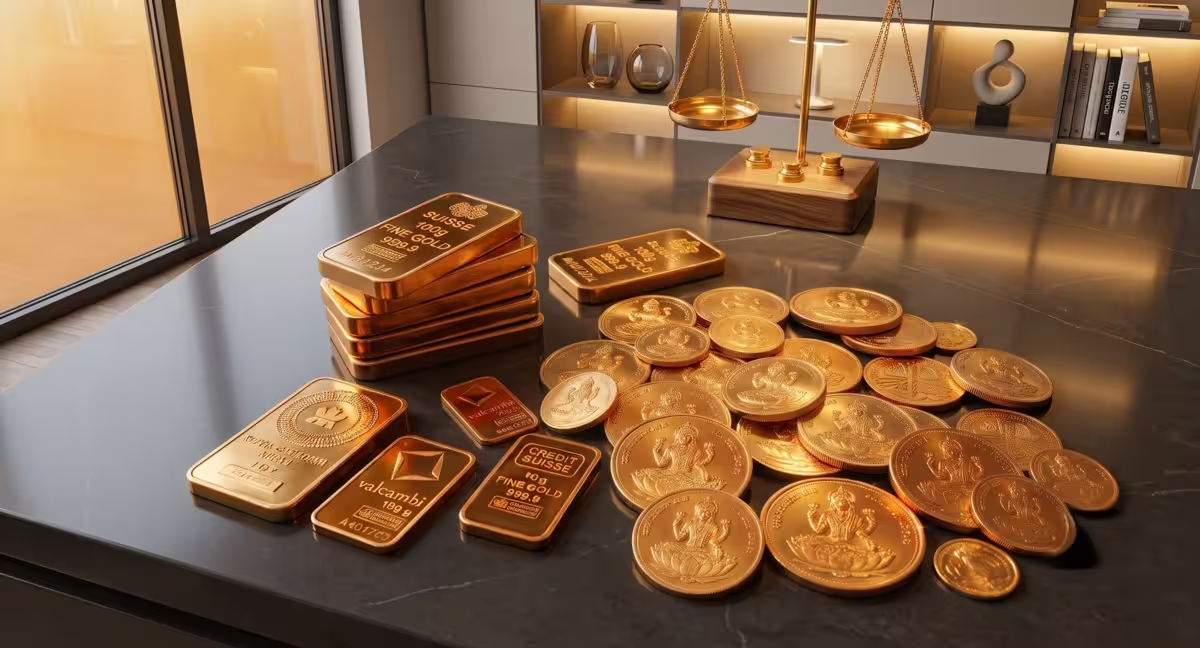
Why Gold Is Different From a Productive Investment
The most important question for a value investor is not whether an asset can rise in price. It is whether the underlying asset can generate economic value and increase its intrinsic worth over time.
1. Gold Does Not Generate Cash Flow
A business can generate revenue, earn profits, retain those profits, reinvest them, expand its operations, and potentially distribute part of the resulting cash to its owners.
A piece of gold cannot do any of those things.
Gold does not produce earnings, pay interest, declare dividends, or retain profits. If you buy one ounce of gold today and put it in a vault for 20 years, you will still have one ounce of gold. Its market price may be much higher, lower, or roughly unchanged depending on what other buyers are willing to pay for it.
This is the fundamental difference between gold and an ownership stake in a productive business.
2. Gold Cannot Internally Compound Capital
Compounding is one of the most powerful forces available to a long-term investor. A good business can reinvest a portion of its earnings and earn a return on that additional capital. The process can repeat year after year.
Gold has no internal mechanism for doing this. It can appreciate in market price, sometimes spectacularly, but that appreciation does not create additional ounces of gold or generate a stream of earnings that can be reinvested.
This does not mean gold cannot deliver excellent returns. It clearly can. It means that the source of those returns is fundamentally different from the compounding of earnings by a productive enterprise.
For example, the World Gold Council reported that the average LBMA gold price rose 44% in 2025 alone, while gold established 53 new all-time highs during the year. Such returns are real for an investor who owned gold. But they came from a change in gold’s market price rather than from gold producing and reinvesting profits.
3. Valuing Gold Is Fundamentally Different From Valuing a Business
A value investor can estimate the intrinsic value of a business by examining its revenues, margins, earnings, free cash flow, assets, liabilities, competitive advantages, capital requirements, and prospects for future growth.
Gold does not provide the same analytical framework.
There is no annual report showing gold’s earnings. There is no management team allocating retained profits. There is no return on capital employed. There is no free cash flow to discount back to the present. And there is no business franchise becoming stronger through reinvestment.
Gold certainly has economic uses and scarcity characteristics, and its price is influenced by interest rates, currencies, inflation expectations, central-bank purchases, investment flows, jewelry demand, technology demand, mine supply, recycling, and geopolitical risk. But determining what one ounce of gold is intrinsically worth is fundamentally different from valuing a productive enterprise.
4. A High Gold Price Does Not Create More Intrinsic Value
When a successful company earns profits and reinvests them productively, the business itself can become more valuable.
Gold is different. A higher price does not make the existing stock of gold more productive. One kilogram of gold remains one kilogram of gold whether it trades at ₹50 lakh or ₹1 crore.
This is why a value investor has to be careful when using past price appreciation as evidence of future investment attractiveness. An asset that has risen dramatically is not necessarily cheap simply because it performed well in the past.
5. Gold’s Future Return Depends Heavily on the Price You Pay
This is true of every investment, but it is particularly important for an asset that does not generate cash flows.
If you buy a profitable company at an attractive valuation, the company can continue generating and reinvesting earnings even if its share price temporarily goes nowhere.
With gold, your return ultimately depends on the price at which someone else is willing to buy it in the future. There is no underlying stream of business earnings working for you while you wait.
This is not the same as saying that gold buyers are relying on a “greater fool.” Gold has legitimate monetary, investment, jewelry, and technological uses, and it has served as a store of value for thousands of years. But the absence of cash flows makes its valuation and expected return inherently more dependent on future market demand and prevailing macroeconomic conditions.
6. Gold Can Remain Unproductive Even When Its Price Soars
The spectacular rise in gold prices since 1990s illustrates an important lesson for value investors: an asset does not have to produce cash flow to generate a spectacular investment return.
Gold has benefited from many powerful forces, including monetary uncertainty, geopolitical tensions, central-bank buying, investment demand, currency movements, and changing expectations for interest rates. The World Gold Council says global gold demand exceeded 5,000 tonnes in 2025, while investment demand rose 84% from the previous year.
Therefore, dismissing gold merely because it is “non-productive” would be too simplistic. A non-productive asset can still appreciate substantially when demand increases faster than available supply.
The value-investing question is narrower: does owning gold fit the way you want your capital to compound?
7. Gold Jewelry Can Be Consumption, Not Investment
Gold jewelry occupies a different place in a person’s financial life when it is bought primarily for personal enjoyment. If you buy jewelry because you enjoy wearing it, for cultural or personal reasons, or as a gift, it is reasonable to think of at least part of the expenditure as consumption rather than investment.
Consumption does not have to justify itself by generating a financial return. A car, a beautiful piece of furniture, artwork, or a vacation can provide personal satisfaction without being expected to compound capital. Gold jewelry can serve a similar purpose while also retaining some residual monetary value.
The distinction becomes important when evaluating jewelry as an investment. The amount you pay for jewelry can include making charges, wastage charges, taxes, and other premiums that are not necessarily recovered when you eventually sell it. Therefore, comparing the original purchase price of jewelry with the subsequent market price of gold can give a misleading impression of the actual investment return.
There is nothing inherently wrong with buying gold jewelry for enjoyment. The important thing is to recognize what you are buying. If the primary purpose is personal use and enjoyment, treat it partly as consumption. If the primary purpose is wealth preservation or investment, evaluate it using the same discipline you would apply to any other asset, including its purchase costs, ownership costs, liquidity, taxes, and eventual selling price.
In other words, gold jewelry can be valuable to you without being a good investment for you. The value you derive from wearing and enjoying it is real, but it is different from the financial return generated by a productive asset.
8. Gold Is Not a Perfect Inflation Hedge
Gold is often described as an inflation hedge, but the relationship is not simple enough to treat gold as a guaranteed protection against inflation over every investment period.
Gold prices respond to many factors besides consumer-price inflation, including real interest rates, currency movements, investment flows, central-bank demand, and geopolitical risk. Consequently, gold can perform strongly when inflation is moderate and can also fall during periods when inflation remains elevated.
It is more accurate to regard gold as a potential long-term store of purchasing power and a monetary hedge rather than as an investment that mechanically rises with inflation.
9. Physical Gold Has Costs That Are Easy to Underestimate
Physical gold is tangible and does not depend on the financial health of a company or borrower. That is an advantage. But owning it also involves costs and practical considerations that are easy to overlook.
- Jewelry can carry making charges, wastage charges, and other premiums over the underlying value of the gold.
- Physical gold requires secure storage, whether at home or in a bank locker.
- Insurance and security arrangements can add to the cost of ownership.
- Bars and coins may also carry premiums over the prevailing market price.
- Taxes and transaction costs affect the investor’s actual cost and eventual return.
None of these factors makes physical gold an unattractive asset by itself. The point is simply that the quoted price of gold is not the same as the investor’s total cost of owning it.
10. Selling Physical Gold Can Be Costly
The other side of buying physical gold is selling it. The market price you see quoted for gold is not necessarily the amount you will receive when you eventually sell your jewelry or other physical gold.
Jewelry can be particularly problematic because the price you paid includes more than the value of the gold itself. Making charges, wastage charges, taxes, and other costs can increase the purchase price, but these amounts may not be fully recoverable when you sell. The jeweler may value the item primarily according to its gold content and purity rather than what you originally paid for the finished piece.
There can also be deductions when jewelry is exchanged or sold, depending on the jeweler, the product, its purity, the condition of the item, and the applicable terms of the transaction. Stones, enamel, solder, and other non-gold components may not receive the same value as the gold itself. In some cases, testing, melting, refining, or other charges may also affect the amount ultimately received.
Taxes are another part of the calculation. The tax treatment depends on the form of gold, how long it has been held, the nature of the transaction, and the investor’s circumstances. Therefore, the return an investor earns should be calculated after considering taxes and transaction costs rather than simply comparing the purchase price with the latest quoted gold price.
This creates an important distinction between the market price of gold and the investor’s net realizable value. If you buy jewelry at a substantial premium to the value of its gold content and later sell it at a price closer to the underlying metal value, gold may have risen considerably while your actual return is much lower.
These costs do not apply equally to every form of gold ownership. Investment-grade bars, coins, and regulated financial products can have a much smaller gap between the underlying gold price and the investor’s transaction value. Nevertheless, anyone considering physical gold should understand the complete round-trip economics: purchase price, ownership costs, selling price, deductions, taxes, and the final amount received.
11. Financial Gold Solves Some Problems but Not the Fundamental One
Investors do not necessarily need to store gold in their homes. Gold ETFs and other regulated financial products can provide exposure to gold without the inconvenience of physically holding bars or jewelry.
These instruments can improve liquidity, security, and convenience. But they do not change the underlying economics of the asset. An investor still owns exposure to the price of gold rather than an operating business that generates and reinvests earnings.
12. Gold Can Have a Legitimate Role Without Being a Core Compounder
This is perhaps the most important qualification to my original argument.
Gold does not have to be a productive asset to have a useful role in a portfolio. Its lack of dependence on corporate earnings and creditworthiness can actually be valuable during financial or geopolitical stress.
Central banks have continued to accumulate gold in substantial quantities. They purchased 863 tonnes in 2025, well above the 2010–2021 annual average of 473 tonnes, according to the World Gold Council.
Gold can therefore serve a purpose that a portfolio full of businesses may not fully provide: diversification against certain monetary, financial, and geopolitical risks.
The Reserve Bank of India describes the Gold Monetization Scheme as an initiative intended to mobilize gold held by households and institutions and facilitate its use for productive purposes.
For that reason, saying that gold is “worthless” or “not an investment” would be just as misguided as saying that gold should be the foundation of every long-term portfolio.
Gold Versus a Productive Business
The difference can be reduced to a simple question:
When you invest your money, do you want to own an asset that can produce more value, or an asset whose value depends primarily on what the next buyer is willing to pay?
A great business can grow its revenues, increase its profits, reinvest capital, strengthen its competitive position, and potentially return increasing amounts of cash to its shareholders.
Gold cannot do this. Its supply can increase through mining and recycling, but an existing bar of gold does not become more productive because its price rises.
That distinction is at the heart of the value-investing argument against making gold a core compounding asset.
So, Should a Value Investor Own Gold?
There is no universal answer.
A value investor who wants to maximize exposure to productive businesses may prefer to allocate most long-term capital to companies that can generate and reinvest earnings at attractive returns.
Another investor may deliberately hold some gold because diversification, liquidity, monetary protection, or protection against extreme financial conditions is worth more to that investor than the opportunity to compound every rupee in productive assets.
The important thing is to understand what you own and why you own it.
Conclusion
My objection to gold as a value investment is therefore not that gold cannot rise. History has decisively demonstrated otherwise.
Nor is the argument that gold has no economic value. It clearly does. Jewelry, technology, central-bank reserves, and investment demand provide genuine reasons for people and institutions to own it. Global gold supply also remains constrained by the economics and physical realities of mining and recycling. In 2025, mine production reached an estimated 3,672 tonnes, while total supply was about 5,002 tonnes.
The argument is much simpler: gold is primarily a store of value and a monetary asset, whereas a good business is a productive asset.
A value investor who buys a wonderful business at a sensible price can potentially benefit from years of rising earnings, retained profits, reinvestment, dividends, and increasing intrinsic value.
Gold gives you no earnings to reinvest. You own the metal, and your eventual return depends primarily on the price at which the market values that metal when you sell.
That is why I would not regard gold as an ideal core compounding investment for a value investor—even while acknowledging that it can be a useful diversifier and store of value within an overall portfolio.
Editorial Note
This article was originally published on August 22, 2011. It has been substantially revised and updated to reflect the subsequent performance of gold and the realities of today’s investment environment. References to gold prices, market conditions, and other events from 2011 are retained only where they provide historical context. The views expressed in the original article have also been reconsidered where subsequent developments have changed the investment case.
With the spurt in gold prices, we have a socioeconomic problem in our neighborhood – the crime rates have gone up with scores of incidents of ornament snatch and run. It has become a nightmare for the police.
Gold price has reached such disproportionate levels tempting many to liquidate the gold assets to keep the cash or to move to some other assets.
The arguments in the main article can hardly be rebutted. But the recent spurt in gold prices is really alluring. In India women do have an uncanny fetish for gold. There are two aspects to this fetish. Women think that they look better in gold ornaments. Secondly, gold, particularly those given out at the time of marriage by bride’s father [locally called streedhan] still works as a security for married women, even for those who are working. But when the necessity arises the ornaments are not sold off on sentimental grounds–especially a self-proclaimed chivalrous husband will not touch his wife’s ornaments during financial calamities. As a result the ornaments are on permanent rest mode in individual bank lockers. The fact remains that unless you can enjoy the value enhancement of a particular product, the increase in it’s value has no meaning.
Tradition, however, continues. When the newly-wed bride becomes a mother-in-law, she gifts her ornaments to her bride-daughter or daughter-in-law. It is a repetition. The newly-wed brides follow their mother or mother-in-law, as the case may be and the ornaments again take their places in bank lockers and are in semi-permanent rest mode.
That’s an excellent strategy, buy and hold for a long time (in this context for generations!), peculiar to only value investors, but on the wrong asset class.
Again I remember Warren Buffett’s words here: