Credit Card Debt Should be the First Leverage to be Retired! Why?
Why Credit Card Debt Should Be Retired First
A credit card can be a useful financial tool when the bill is paid in full every cycle. It can provide convenience, security, rewards, and a short interest-free period. The trouble begins when we start treating that interest-free period as an invitation to carry the balance forward.
If you cannot pay your credit card bill in full, don’t treat the minimum payment as a solution. It is only a way of keeping the account current while the unpaid balance continues to cost you money. Once credit card debt starts rolling from one billing cycle into the next, it can become one of the most expensive forms of debt you carry.
And if you already have several debts, my view is simple: credit card debt should usually be the first debt you try to retire.
The Convenience of a Credit Card Can Become a Trap
Like many people, I used to dislike carrying cash everywhere. The risk of losing it, the convenience of paying with a card, and the interest-free credit period made the credit card an attractive alternative to cash.
There is nothing inherently wrong with that. In fact, when you spend money you already have and pay the entire credit card bill by the due date, a credit card can be quite convenient.
The problem is that a credit card can make spending feel almost effortless. You don’t see the money leaving your bank account at the moment you make the purchase. The psychological distance between spending and paying can encourage purchases that you might have avoided if you had to hand over cash immediately.
I experienced that myself. There were months when I ended up spending more than I earned. The convenience that initially looked like an advantage had quietly become a curse.
The Minimum Payment Is Where the Trouble Begins
Then comes the apparent savior: the minimum payment.
You have spent more than you should have, but the credit card statement tells you that you don’t have to pay the entire amount. Pay only the minimum, carry the rest forward, and everything appears manageable.
That is how the debt trap can begin.
The next month, there is another statement. You make another minimum payment. Interest is added to the unpaid balance, and perhaps you use the card again because there is still some available credit. Gradually, you can find yourself living from one credit card statement to the next.
With multiple cards, the situation can become even worse. You may start shifting expenses from one card to another, using one source of credit to keep another account under control. It is essentially the old game of robbing Peter to pay Paul.
At some point, a large portion of your monthly income can disappear simply into servicing accumulated debt, leaving little money to reduce the principal. What looked like an easy way to spread a purchase over a few months can turn into a long and expensive commitment.
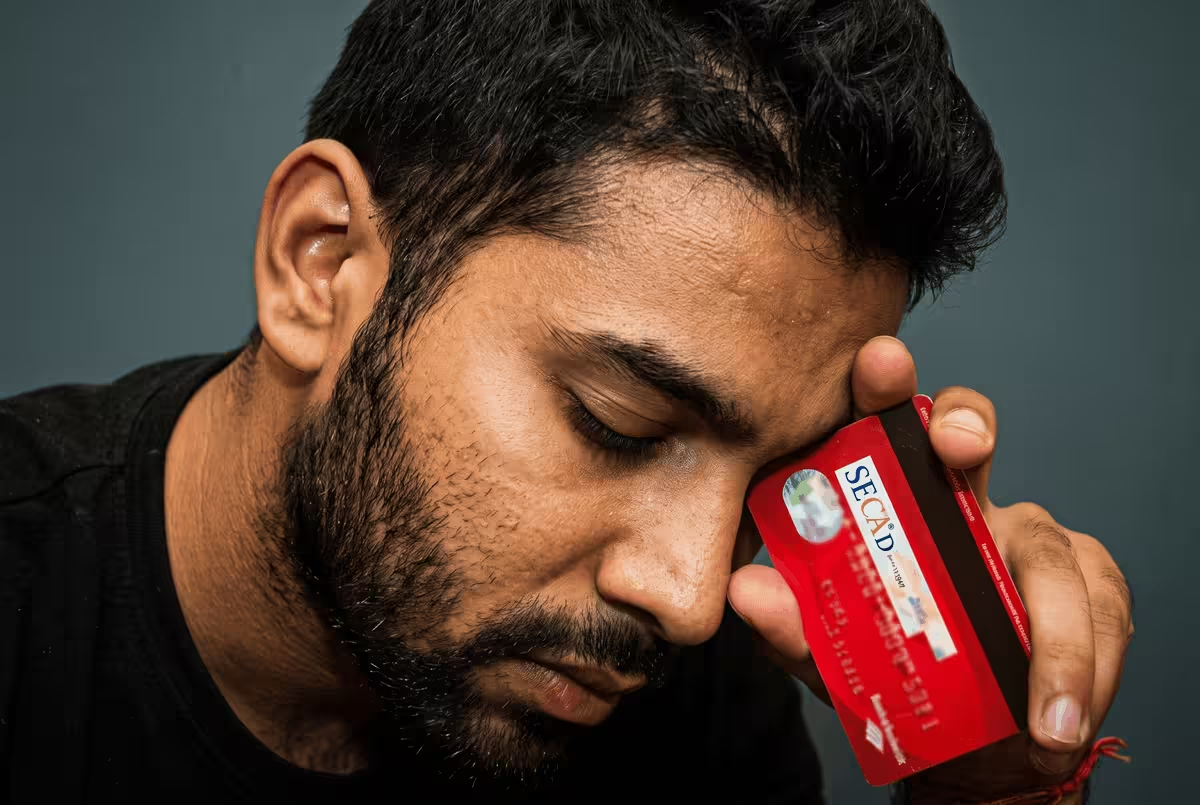
The Interest Rate Is the Real Problem
When the debt starts becoming uncomfortable, people often focus first on their spending. That is necessary, but there is another number on the statement that deserves your immediate attention: the interest charged on the outstanding balance.
Credit card interest rates can look deceptively harmless when expressed as a monthly percentage. A rate such as 2% or 3% per month may not sound particularly alarming until you put it into an annual perspective. The Reserve Bank of India requires card issuers to disclose the annualized percentage rate and clearly explain the implications of carrying an outstanding balance.
For example, 3% per month is 36% on a simple nominal annual basis. If that monthly rate were applied consistently with monthly compounding, the effective annual rate would be about 42.6%. A 1.5% monthly rate is 18% nominal, but about 19.6% effective annually.
And the interest is only part of the cost. Depending on the card and the circumstances, there can also be late-payment charges, cash-advance fees, annual fees, foreign-transaction charges, and other costs.
That is why credit card debt deserves special attention. When you are paying such a high rate to someone else, every rupee or dollar that remains outstanding is working against your financial future.
Why Retire Credit Card Debt Before Other Debt?
Suppose you have a mortgage, a personal loan, and a credit card balance. The fact that all three are called “debt” does not make them financially equivalent.
A mortgage, for example, may carry a relatively moderate interest rate and may be structured over many years. A credit card balance can carry a dramatically higher rate. Paying down a debt with a very high interest rate gives you a guaranteed financial benefit equal to the interest you no longer have to pay.
This is why I consider credit card debt a particularly dangerous form of leverage. You are borrowing against your future income at a cost that can overwhelm the returns you reasonably expect from most investments.
Think about it this way: if your credit card is charging you an effective rate of more than 30% a year, what investment can you reasonably expect to earn more than that, consistently, after taxes and costs, without taking substantial risk?
Trying to invest while carrying expensive revolving credit card debt can therefore be like filling a bucket with water while someone else is steadily making a large hole in the bottom.
What If You Cannot Pay the Bill in Full?
Ideally, the answer is simple: stop carrying the balance forward and pay the statement balance in full.
But life does not always cooperate. An unexpected expense, a period without income, or a genuine emergency can leave someone unable to pay the entire bill, which is why an emergency fund matters.
If that has happened to you, don’t make the mistake of treating the balance as a normal long-term loan. Make a plan to eliminate it as quickly as reasonably possible.
First, stop adding new discretionary spending to the balance. Then examine your income and expenses, cut what can be cut, and direct as much available cash flow as possible toward the card. If you have multiple high-cost balances, prioritize the one with the highest effective interest rate while keeping the others current.
The important thing is to stop the revolving balance from becoming a permanent part of your finances.
Should You Sell an Investment to Pay Off Credit Card Debt?
This is where people sometimes become emotionally attached to their investments. They may think, “I don’t want to sell my investment. It could appreciate in the future.”
That may be true. But the comparison should be made rationally.
If you are carrying credit card debt at a very high interest rate, paying it off can provide a certain saving on future interest. The return you expect from an investment, on the other hand, is uncertain.
So, if you already have investments and are struggling under expensive credit card debt, it can make sense to examine whether one of those assets should be sold to eliminate the debt. I would start by looking at assets with the lowest expected future return, the weakest investment case, or the least strategic importance to your long-term portfolio.
That could mean selling a bond, stock, gold, or another asset. It may feel painful to sell an investment, particularly one you have held for a long time. But holding an investment while simultaneously paying an exceptionally high rate on credit card debt does not automatically make financial sense.
Of course, taxes, exit costs, liquidity needs, and the quality of the investment should also be considered before selling anything. The objective is not to liquidate good investments indiscriminately. The objective is to eliminate an extraordinarily expensive liability when doing so is financially sensible.
The Best Credit Card Strategy Is to Avoid Revolving Debt
The easiest credit card debt to retire is the debt you never create.
Use a credit card for convenience, security, or rewards if those benefits are useful to you. But treat the card as a payment instrument, not as an extension of your income.
If you cannot afford to pay for something from your available resources, putting it on a credit card does not make it affordable. It merely postpones the payment and can make the eventual cost much higher.
One simple rule can prevent a great deal of trouble: if you use a credit card, aim to pay the statement balance in full every billing cycle.
If you find yourself repeatedly unable to do that, the problem is no longer the credit card. It is the gap between your spending and your income.
Credit Card Debt Is a Slow Poison to Your Finances
Credit card debt rarely feels dangerous at the beginning. A small outstanding balance does not look frightening. A minimum payment can make a large statement appear manageable. Another card can provide another temporary escape.
But debt has a way of becoming less manageable when it is repeatedly carried forward.
The longer expensive credit card debt remains outstanding, the more of your future income is committed to paying for past spending. Money that could have gone toward savings, investments, a home, your children’s education, or simply greater financial freedom is instead transferred to the credit card issuer.
That is why I would not wait for credit card debt to become a six-figure problem before taking action. If you are carrying a balance today, make eliminating it a priority. If you are not carrying a balance, make sure you don’t casually start doing so.
Credit cards can be useful servants, but they can become expensive masters. Pay the bill in full whenever you can. And if you cannot, make retiring that debt your first financial priority.
I’ve been in such a trap. Once our credit card loan outvalued the value of our house. Me and my husband worked hard for more than four years to get out of the debt. It’s a ghost that got hold of us at youth. We now use only greenback, never could imagine those horrible days again. That’s a moral we convey our kids.
I strongly agree on this. You also focus on loans as well… debt itself is a slow poison…. We can depend on recurring deposits and debit cards instead… just think… just an apprx: 200,000 loan @ 8.5% – repayment track 60 months, interest fixed, flat installments 4250 every month will amount to 250,000… and why did you need the loan, because we were not saving for five years… 4250 every month recurring deposit will amount to much larger amount but we rarely have the commitment for that… we are scared missing one installment when it comes to the same installment for a debt…
Be satisfied with what we have at present and plan well for the future… once your RD is mature get that thing whatever you wanted in a better and more technologically form…