BLS International: Why Its Stellar Potential Justified a Bargain Buy?
The Genesis of the Decision
From Watchlist to Portfolio
I tracked BLS International Services closely throughout the entirety of 2024. A small cap with a market capitalization of around ₹13,000 crores. It was a year defined by strategic observation. However, I did not buy heavily immediately. Instead, I studied the market movements daily. Consequently, the stock remained a top priority in my analysis. My watchlist is rigorous. Only the best companies survive there for long. BLS International earned its spot rightfully. The company showed immense resilience during market corrections. Moreover, the unique business model fascinated me. Therefore, I paid attention to every quarterly result.
The 2024 performance was consistently stellar. Yet, I waited patiently for the right moment. Patience is a vital virtue in investing. I wanted to see stability. Furthermore, I looked for confirmation of the growth story. The stock price fluctuated, offering various entry points. But I held back my major capital. I needed absolute conviction before deploying funds. Finally, that conviction grew strong by late 2024. The data was undeniable. Thus, the transition began. I moved from a spectator to a serious investor. This journey was not impulsive. Rather, it was a calculated evolution. The year 2024 provided the necessary evidence. Hence, I prepared for aggressive buying in 2025.
The Investment Philosophy
My philosophy relies strictly on data. Specifically, return ratios matter most to me. BLS International fits these criteria perfectly. For instance, the current ROCE is 33.6%. This is an exceptional number for any industry. Furthermore, the 10-year average ROCE is 27.7%. Consistency is key here. The company has improved gradually over time. Additionally, the ROE tells a similar positive story. Currently, the ROE stands at a healthy 34.3%. This indicates high capital efficiency. Shareholders are being rewarded well.
I also demand growth from my investments. Fortunately, sales grew 17.2% on average over the last decade. Profit growth was even better. It averaged 35.8% over the same 10 years. Such numbers are rare in the Indian market. Thus, the fundamental case was incredibly solid. Moreover, I avoid heavy debt. High debt kills companies during economic downturns. BLS International has a debt-to-equity ratio of only 0.19. This is virtually negligible. Therefore, the balance sheet is robust. This safety net is crucial. It allows the company to navigate economic storms. Consequently, my investment philosophy was fully satisfied. The metrics aligned with my strict standards.
The “Tracking Position” Strategy
I established a minor position in 2024. This is often called a “tracking position.” It keeps me focused on the company. Owning a stock changes your mindset completely. You read the annual reports differently. Therefore, I bought a few shares initially. It was not a full allocation. Rather, it was a strategic foothold. This strategy works well for my psychology. It forces me to follow news updates. Consequently, I caught every corporate announcement in 2024. The price volatility didn’t scare me. Instead, it provided valuable data points.
I watched the support levels form. The management’s execution was visible through this small stake. My confidence grew month by month. Eventually, I was ready for more exposure. This small stake prevented me from forgetting the stock. It acted as a constant reminder. Furthermore, it allowed me to track the price action. I saw how the stock reacted to bad news. It held up well. This resilience is a good sign. Hence, the tracking position served its purpose. It paved the way for the major buy. By the end of 2024, I was prepared. The tracking phase was successfully completed.
Identifying the Opportunity
The real buying started in February 2025. The valuation became too attractive to ignore. Specifically, the PEG ratio dropped below 0.5. This signals massive undervaluation relative to growth. Moreover, the market cap was around ₹13,000 crores. This is a sweet spot for potential mid-cap growth. I calculated the intrinsic value carefully. My model suggested a fair price of around ₹340. The market price was significantly lower. Hence, the price to intrinsic value was less than 1. This offered a margin of safety.
Additionally, the earnings yield was around 6%. This is comparable to risk-free returns. However, this stock offers growth too. Therefore, the risk-reward ratio was favorable. The Price to Sales ratio was around 5. This is reasonable for a high-margin business. I also looked at the Free Cash Flow yield. It hovered around 5%. Cash flow is the ultimate truth. Thus, the financial health was pristine. I started buying in tranches. This buying continued until November 2025. And probably may go beyond. I accumulated shares systematically. The divergence between price and value was clear. Consequently, I acted with conviction. The opportunity was too good to miss.
The Business Moat & Industry Landscape
Understanding the Visa Outsourcing Model
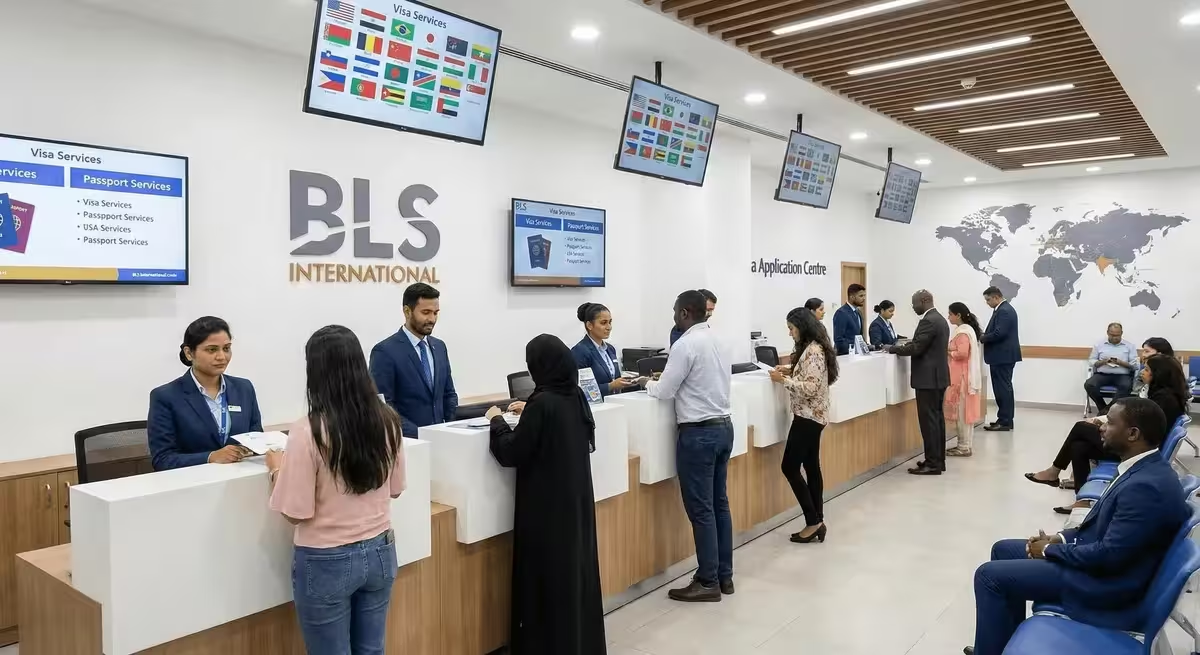
The core business model is brilliant. Governments delegate administrative tasks to specialized firms like BLS. The company handles data entry and biometrics. However, the crucial decision-making remains with the embassy. This structure reduces the diplomatic burden significantly. Consequently, the company earns service fees per applicant. These fees are collected upfront. Thus, the working capital cycles are highly efficient. It operates as an asset-light model. They rent centers rather than owning real estate. Therefore, the return on capital remains exceptionally high. We clearly see this in the current ROCE of 33.6%.
Operating leverage kicks in as volume increases. Fixed costs stay relatively stable. Meanwhile, revenue surges with global travel demand. This scalability is a massive advantage. I observed this dynamic throughout 2024. The cash flow generation is robust. Specifically, the free cash flow yield is around 5%. This cash acts as fuel for further growth. Furthermore, they do not take credit risks. Customers pay before receiving services. Hence, bad debts are virtually non-existent. This financial hygiene attracted me immensely. The model is a cash machine.
High Switching Costs
Governments rarely switch service providers. Security is the primary reason for this stickiness. BLS handles sensitive citizen data daily. Establishing such trust takes years of impeccable service. Once established, it is incredibly hard to break. Therefore, existing contracts are very sticky. Competitors face high barriers to entry here. They must prove flawless security records. Furthermore, the technical integration with embassy systems is complex. Changing vendors disrupts diplomatic operations. Diplomats generally dislike such administrative disruptions. Consequently, renewal rates are historically very high.
This provides clear revenue visibility. Investors love predictable cash flows. BLS benefits from this bureaucratic inertia. The moat is deep and defensible. It is built on trust, security, and reliability. Hence, the business enjoys long-term stability. During my 2024 watchlist phase, I monitored contract renewals. The company retained key clients successfully. This validated the switching cost thesis. Moreover, the reputation acts as a referral. One satisfied government leads to another. Thus, the moat widens with every year.
The Oligopoly Structure
The global market is effectively an oligopoly. Only three major players dominate the landscape. VFS Global is the current market leader. BLS International is the strong, aggressive challenger. TLSContact is the third significant player. New entrants struggle significantly to penetrate this market. The barriers to entry are massive. Governments require a proven global presence. Building a network across 60+ countries is difficult. BLS has already achieved this scale. Thus, they enjoy limited competition. Pricing power is respectable in this structure.
They don’t fight catastrophic price wars. Instead, they compete primarily on service quality. This rational market structure protects margins. The 10-year average profit growth of 35.8% reflects this. Everyone in the oligopoly makes money. Therefore, BLS is positioned beautifully for the future. The market cap of around 13,000 crores allows room for growth. They can steal market share from the leader. Additionally, the total addressable market is growing. More countries are outsourcing visas. Consequently, the pie is getting bigger. BLS is eating a larger slice.
Digital Transformation
The world is rapidly moving digital. BLS International is leading this technological shift. They offer e-visa services for many nations. This reduces the need for physical infrastructure. Margins are generally higher in this digital segment. Furthermore, tech integration improves processing speed. Applicants prefer online convenience over physical queues. BLS provides seamless portals for these users. Consequently, customer satisfaction scores rise. The company invests heavily in AI. This helps in efficient fraud detection.
Security is enhanced significantly through technology. Governments appreciate this tech-savviness. It secures future contracts effectively. The old manual ways are dying out. BLS is future-proofing itself aggressively. This adaptation keeps them relevant. Hence, technology acts as a tailwind. It drives both growth and operational efficiency. My minor position in 2024 allowed me to track these tech rollouts. The company is not a dinosaur. It is an agile tech-enabled services firm. This distinction is vital for long-term value. The ‘International’ in their name is justified, but their operations are fundamentally driven by tech.
Beyond Visas
The company is not just about visas. They are diversifying intelligently into other verticals. Citizen services are a huge growth area. For instance, they manage Sewa Kendras in Punjab. They deliver birth certificates and licenses there. This provides domestic revenue stability. It offsets international travel seasonality. Moreover, they act as banking correspondents. They bring banking to rural India. This is financial inclusion at scale. The volume here is massive. Per-transaction fees add up quickly.
Thus, the revenue base is broadening. Dependence on one single vertical is reducing. This risk mitigation is excellent strategy. It creates a robust business model. The growth runway is long and diverse. The promoter holding of 70.4% ensures alignment. They are building a conglomerate of services. The company is essentially a government-to-citizen bridge. This diversification was a key factor for me. It smooths out the earnings curve. Therefore, the stock is less volatile fundamentally.
The real art of finding multibaggers lies in recognising a sprouting seed with the potential to flourish!
The Pivotal Year 2024 – Events & Catalysts
The iData Acquisition
The most significant event of 2024 was undoubtedly the acquisition of iData. This deal was completed in July 2024. It was a game-changer for the company’s valuation. BLS acquired a 100% stake in this Turkey-based provider. The deal was valued at approximately ₹720 crores. I watched this development closely. It signaled a major shift in strategy. They were no longer just winning small contracts. Instead, they were buying established market share.
This acquisition was immediately earnings accretive. Consequently, the financial impact was visible in the subsequent quarters. iData specializes in visa services for Germany and Italy. These are high-margin Schengen regions. Furthermore, the acquisition was funded prudently. They used internal accruals and debt. However, the debt was manageable. This move demonstrated capital allocation discipline. Management did not dilute equity for this purchase. Thus, shareholder value was preserved. This event alone justified a higher multiple. It proved that BLS could execute large cross-border deals.
Strengthening the European Footprint
Europe is the holy grail of the visa business. The volumes are high, and the fees are lucrative. The iData deal unlocked Germany and Italy significantly. Before this, BLS had a limited presence in these specific missions. Suddenly, they became a dominant player there. Additionally, they strengthened their relationship with the Spanish government. The renewal of the Spain global contract was a key validation. I monitored this renewal anxiously in early 2024. Losing it would have been catastrophic.
Fortunately, they retained it. Moreover, they expanded operations. They added new centers in the Schengen zone. This created a defensive moat around their European revenue. Competitors found it harder to displace them. The Schengen visa demand rebounded strongly in 2024. Travel numbers surged past pre-pandemic levels. BLS was perfectly positioned to capture this traffic. Therefore, their European revenue engine fired on all cylinders. This geographic diversification reduced reliance on any single country. It made the revenue stream robust and resilient.
The BLS E-Services IPO
Early 2024 witnessed a massive value-unlocking event. The subsidiary, BLS E-Services, went public in February. The market response was euphoric. The IPO was oversubscribed more than 160 times. This listing highlighted the hidden value within the parent company. BLS International retains a majority stake in this subsidiary. Consequently, the market cap of the parent company benefited. I analyzed the subsidiary’s business model separately. It is an asset-light digital service provider.
The cash raised from the IPO fueled further growth. It gave the group a war chest for acquisitions. Furthermore, it created a currency for future M&A. The listing also improved corporate governance transparency. Investors could now see the digital business metrics clearly. This transparency reduced the holding company discount. The parent company’s stock reacted positively. However, the long-term benefit is even greater. It allows the digital business to grow independently. This event was a masterstroke by the management. It crystallized the value of their non-visa business.
Contract Wins and Renewals
2024 was not just about acquisitions. Organic growth remained impressive throughout the year. The company announced several key wins. For instance, they expanded visa services for Hungary in Jordan and Canada. They also won the contract for Italy in Pakistan. These specific wins add up significantly. Each new center increases the operating leverage. Additionally, they secured the Portugal contract for Russia and Morocco. I tracked these press releases religiously. Every win confirmed the “growth” part of my thesis.
They also secured a massive contract from UIDAI in India. This involves providing Aadhaar services. While margins here are lower, the volume is consistent. It provides a steady baseline of domestic revenue. Furthermore, they expanded attestation services in Africa. The diversification into new geographies was relentless. They entered markets where competition is sparse. This “blue ocean” strategy is smart. It avoids direct confrontation with larger rivals. Consequently, they built a diversified global portfolio. The risk of a single contract failure was minimized.
Management Commentary 2024
The earnings calls in 2024 were very revealing. Joint Managing Director Shikhar Aggarwal was consistently bullish. He spoke clearly about “margin expansion.” The strategy was to move from partner-run to self-managed centers. Self-managed centers yield significantly higher EBITDA margins. I listened to his guidance on the EBITDA targets. He guided for margins in the late 20s. The results followed his words. This execution capability built my trust.
He also emphasized “tech-enabled services.” The focus was on reducing manual intervention. This lowers employee costs over time. Furthermore, the management was transparent about challenges. They admitted when visa volumes dipped in certain regions. This honesty is refreshing in small-cap companies. They also discussed their capital allocation policy. The focus remained on high-ROCE acquisitions. They ruled out unrelated diversification. This discipline is what I look for. Therefore, the qualitative factors aligned with the quantitative data. The management passed the “scuttlebutt” test with flying colors.
Financial Forensics – The Metrics That Matter
Analyzing the Return Ratios
My analysis always begins with capital efficiency. Specifically, Return on Capital Employed (ROCE) is my primary filter. BLS International displays a stunning trend here. The current ROCE stands at 33.6%. This is not a one-time wonder. Interestingly, the 3-year average ROCE is 32.1%. Furthermore, the 10-year average is 27.7%. This trajectory shows clear improvement. The business is becoming more efficient with scale. Such consistent improvement is rare. Typically, returns diminish as companies grow larger. Here, the opposite is happening.
The Return on Equity (ROE) paints a similar picture. It currently sits at 34.3%. This is significantly higher than the 10-year average of 28.5%. Consequently, the company is generating massive value for shareholders. Every rupee of equity produces substantial profit. I scrutinized these numbers heavily in 2024. A company earning 30% on capital is a compounding machine. It can reinvest profits at high rates. Thus, external funding becomes unnecessary. This self-sustaining growth loop is powerful. It was a decisive factor for my purchase.
Profit Growth Analysis
Growth is the engine of stock returns. However, not all growth is equal. I look for profit growth exceeding sales growth. BLS delivered exactly this. The average sales growth over the last 10 years was 17.2%. This is a respectable double-digit number. Yet, the average profit growth was a staggering 35.8%. This divergence is beautiful. It indicates massive operating leverage. As revenue grows, costs grow slower. Therefore, margins expand naturally.
This 35.8% profit growth explains the stock’s historical performance. Earnings drive stock prices eventually. In 2024, I checked if this trend remained intact. The quarterly results confirmed it. The bottom line continued to swell. Moreover, this growth was organic and inorganic. The acquisition strategy complements the core business. It adds revenue without bloating costs proportionally. Hence, the profit engine is highly efficient. Finding a company with 35% long-term profit growth is difficult. Finding one available at a reasonable valuation is even harder. BLS was that rare find.
The Balance Sheet Strength
A strong offense needs a strong defense. In investing, the balance sheet is your defense. I strictly avoid over-leveraged companies. Debt kills during economic downturns. BLS International has a debt-to-equity ratio of just 0.19. This is incredibly low for an acquiring company. It implies the company is virtually debt-free. They fund growth through internal accruals. This financial independence is comforting. It removes bankruptcy risk almost entirely.
Furthermore, low debt means low interest costs. Interest payments do not eat into profits. Consequently, net profit margins remain healthy. During the high-interest rate cycle of 2024, this was crucial. While other firms struggled with debt service, BLS thrived. They had the flexibility to borrow if needed. However, they chose prudence. This conservative approach resonates with me. It protects my capital from permanent loss. A clean balance sheet is a sleep-easy factor. It allows investors to hold through volatility.
Cash Flow Consistency
Accounting profits can be manipulated. However, cash flow is the ultimate truth. I focused heavily on the Free Cash Flow (FCF). The company consistently converts accounting profit into cash. The Free Cash Flow yield was around 5%. This is a very attractive yield. It means the business generates real, distributable cash. This cash acts as fuel for growth. The cash can be used for dividends or to fund strategic acquisitions. BLS has effectively utilized its cash for both. Instead of hoarding it, BLS has used it efficiently to fund strategic acquisitions like iData. Moreover, they have rewarded shareholders through consistent dividends and two bonus issues in the past. This balanced capital allocation builds long-term trust.
I compared the cash flow from operations with net profit. The two metrics tracked closely over the years. This indicates high earnings quality. There were no aggressive accounting gimmicks. Additionally, the working capital cycle is negative or very low. Customers pay upfront for visas. Expenses are paid later. Thus, the customers essentially fund the operations. This is the holy grail of business models. It releases cash rather than consuming it. Therefore, the 5% FCF yield was a screaming buy signal.
The Magic of Promoter Holding
Skin in the game is essential. I want management to suffer if the stock falls. Promoter holding in BLS is 70.4%. This is exceptionally high. It signals massive confidence from the owners. They are not selling out. Instead, they are holding tight. This alignment of interest is vital. When promoters own 70%, they think like shareholders. They focus on long-term value creation. They avoid short-term gimmicks.
Throughout 2024, I watched for insider selling. There was no alarming exit by the key family. In fact, their high stake restricts the free float. This supply scarcity can drive prices up. When demand rises, limited shares are available. Consequently, the stock price reacts sharply to good news. This technical dynamic supports the fundamental thesis. A 70% owner wants the stock price to go up. Therefore, I am betting alongside the people running the show. This is the safest way to invest.
Valuation Analysis – Why It Was Cheap
The PEG Ratio Argument
The Price/Earnings-to-Growth (PEG) ratio is my favorite valuation tool. It contextualizes the P/E ratio against growth rates. For BLS International, this ratio was consistently less than 0.5. A PEG ratio under 1.0 is generally considered cheap. A ratio under 0.5 is an absolute bargain. It implies the market severely underestimated the future growth. The company was growing profits at 35.8%. However, the market multiple did not reflect this velocity. This disconnect created a massive opportunity.
I wasn’t just buying earnings. I was buying rapidly expanding earnings for a low price. Consequently, the margin of safety was huge. Peter Lynch famously preferred stocks with a PEG below 1. BLS satisfied this criterion comfortably. The market was pricing it like a slow-growth utility. In reality, it was a high-growth compounder. Therefore, the downside risk was mathematically limited. The stock was mispriced relative to its own velocity. This anomaly was the primary trigger for my aggression.
Intrinsic Value Calculation
Price is what you pay; value is what you get. I calculated the intrinsic value using conservative estimates. My model factored in the free cash flows. I also used the historical growth rates as a baseline. My approximate intrinsic value came to around ₹340. The market price in 2025 was hovering around or below. This gap represents the investor’s profit zone. I prefer buying assets for 50 paise on a rupee, although Mr. Market didn’t offer that much value proposition.
However, the Price to Intrinsic Value ratio was clearly less than 1 for significant period. This provided a comfortable cushion against calculation errors. Even if growth slowed, I was safe. The market inefficiency was glaring. Perhaps geopolitical headlines kept the price suppressed. Regardless, the math was undeniable. I trusted my valuation model over market sentiment. The divergence between price and value cannot last forever. Eventually, the gap closes. I positioned myself to benefit from this inevitable correction.
Price to Sales Ratio
The Price to Sales (P/S) ratio hovered around 5. Some conservative investors might consider this high. However, P/S must be viewed alongside profit margins. High-margin businesses deserve higher sales multiples. BLS operates with very healthy EBITDA margins. Therefore, a 5x sales multiple is justifiable. It reflects the high quality of their revenue. Furthermore, this revenue converts efficiently into cash. Asset-light businesses often command premium multiples.
The market pays for low capital intensity. I compared this metric to other platform businesses. The valuation was in line with high-quality peers. Thus, the P/S ratio was not a red flag. It was fair for the operational leverage offered. Moreover, sales were growing at double digits. A 5x multiple on growing sales compresses quickly. If sales double, the entry valuation becomes very cheap. Hence, looking at the forward P/S is crucial. The trailing number justified the entry.
Earnings Yield vs. Bond Yield
I always compare equity risk to risk-free bonds and bank fixed deposits. The earnings yield is the inverse of the P/E ratio. For BLS, this yield was over 5%. In comparison, government bonds and fixed deposits of the banks offered somewhat similar yields. However, bonds and fixed deposits offer zero growth. Their coupons and interests are fixed forever. BLS offers a 5% starting yield plus 35% growth. The choice was obvious. Why accept fixed returns when you can have growth?
This “equity risk premium” was attractive. It compensated well for the market volatility. The stock was essentially a growing bond. This perspective made holding it very easy. If the stock price stays flat, earnings accumulation supports it. If the price drops, the yield becomes even better. Consequently, the risk-reward ratio favored the buyer. I treated the shares as a business ownership stake. The underlying yield provided a fundamental floor.
Historical Valuation Trends
I contextualized the valuation historically. I analyzed the 5-year and 10-year median P/E ratios. During the later part of 2025, the stock traded below its historical averages. This implies a potential for mean reversion. Typically, high-growth phases command premium multiples. Here, the multiple was compressing while growth accelerated. This is a rare divergence. Usually, high growth leads to multiple expansion.
The market was essentially skeptical of the sustainability. I bet against this skepticism. Eventually, the price catches up to performance. The downside seemed limited by historical support levels. Conversely, the upside was uncapped. Buying below the median valuation is a proven strategy. It acts as a safety net. It ensures you are not overpaying for hype. The numbers looked good. Hence, I started buying in tranches.
Risk Assessment & Mitigation
Geopolitical Risks
The visa business is inherently sensitive to geopolitics. Diplomatic tensions can halt travel instantly. For example, the India-Canada diplomatic row in late 2023 was a concern. It temporarily affected visa processing volumes. Furthermore, global conflicts like the Russia-Ukraine war disrupt regional mobility. I evaluated this risk factor seriously. BLS operates in sensitive regions. Therefore, their revenue is tied to cross-border peace. A major global war could be devastating.
However, the company’s diversification mitigates this effectively. They operate in over 66 countries. If one corridor closes, others often remain open. For instance, while Western travel slowed, Middle Eastern travel surged. This geographic spread acts as a natural hedge. Additionally, they handle domestic services. The citizen services business in India is immune to geopolitics. Consequently, the revenue floor is protected. I accepted this risk as part of the business model. The diversification strategy provides adequate insulation. Hence, I remained confident despite global headlines.
Regulatory Risks
Governments frequently change visa policies. A sudden policy shift can reduce application volumes. For example, a country might grant visa-free entry to tourists. This would eliminate the need for processing services. Such regulatory changes are unpredictable. Investors hate uncertainty. I analyzed the likelihood of mass visa waivers. While some tourism-heavy nations do this, security concerns are rising. Governments want more screening, not less. Therefore, the trend favors outsourcing rather than elimination.
Furthermore, contracts often have minimum guarantee clauses. These clauses protect the service provider’s basic costs. BLS also adapts quickly to new rules. When e-visas replaced paper visas, they pivoted. They now manage the e-visa portals for several nations. Thus, regulatory change often becomes a business opportunity. They monetize the new complexity. The risk is real but manageable. The economic moat protects them here. Governments need a partner to implement these complex changes. BLS is that reliable partner.
Dependence on Key Contracts
Historically, BLS relied heavily on the Spain contract. Concentration risk was a valid concern in previous years. Losing a major client can cripple revenue. I scrutinized the revenue split carefully in 2024. The reliance on Spain has decreased significantly. The win of the Slovakia contract and others helped. Moreover, the iData acquisition added Germany and Italy. This broadened the revenue base considerably.
The citizen services segment further dilutes this concentration. Now, no single contract dictates the company’s survival. This was a critical checkpoint for my 2025 purchase. I wanted a diversified conglomerate, not a single-client vendor. The management is actively aggressively seeking new missions. They are bidding for tenders in Latin America and Africa. Consequently, the client concentration risk is falling every quarter. The business is becoming a global enterprise or rather a global platform. Therefore, the “key man risk” regarding contracts has subsided. The portfolio approach to contracts is working.
Execution Risk in Acquisitions
Acquisitions are notoriously difficult to execute. Many companies fail to integrate new businesses successfully. The integration risk for iData was significant. Cultural differences between Indian and Turkish teams could arise. Furthermore, overpaying for an acquisition destroys value. I monitored the post-acquisition commentary closely. Management seemed focused on retention. They kept the existing operational teams in place. This continuity reduces execution friction.
Moreover, BLS has a track record of successful integration. Their previous acquisition of Zero Mass Private Ltd was handled well. It is now a core part of their domestic business. This history gave me comfort. They don’t just buy revenue; they buy capabilities. The debt taken for iData was also modest. Thus, financial risk from the deal was low. I view the management as prudent allocators of capital. They mitigate execution risk through careful due diligence. Hence, I viewed the iData deal as a catalyst, not a threat.
The Buying Strategy – Execution in 2025
Technical Setup in February 2025
The fundamental analysis was complete by late 2024. However, I needed a technical entry point. I found it since the first quarter of 2025. The stock price had consolidated for weeks. Volatility contracted significantly. This often precedes a major move. I watched the moving averages closely. Specifically, the price crossed below the 200-day Moving Average in February 2025. This is a classic bearish signal. It indicated a change in the long-term trend. Consequently, the “buy” trigger was pulled.
Volume analysis confirmed the breakdown. Selling interest appeared on the charts. Institutional investors were likely selling. Therefore, I executed my first tranche. I did not try to catch the absolute bottom. Catching falling knives is dangerous. Instead, I dipped one leg slightly. The setup offered a clear invalidation level. If the price fell sharply, I could exit with small losses. Fortunately, the support held firm. The technicals aligned perfectly with the fundamentals. Thus, the timing in February was precise. It marked the start of the accumulation phase.
The Psychology of Accumulation
Buying a full position takes mental discipline. I did not rush. Instead, I bought in tranches from February to November 2025. This gradual approach reduces timing risk. If the price dropped, I bought more cheaper. If it rose, I bought confirmation. Emotional stability is crucial here. Market noise was loud during these months. Global headlines often caused temporary panic. However, I stuck to the plan. My minor position from 2024 helped significantly. It gave me the confidence of a long-term holder.
I treated the stock like a savings account. Every month, I deployed capital systematically. This removed the urge to gamble. I ignored daily price fluctuations. Instead, I focused on the quarterly business updates. The business kept performing well. Therefore, my conviction deepened over time. This slow accumulation prevents buyer’s remorse. You never feel like you went “all in” at the wrong time. It turns investing into a process, not an event. Consequently, I built a substantial position without stress.
Averaging Up vs. Averaging Down
My strategy primarily involved averaging down. Since I entered during a breakdown, I bought into weakness. The market offered discounts throughout in 2025. I utilized these moments to lower my average cost. Many investors fear buying falling stocks. However, price follows value. If the intrinsic value is ₹340, buying at ₹200 is a steal. Buying even lower is better. Therefore, I accumulated heavily during the weakness.
As the support held, the trend stabilized. However, I strictly avoided averaging up. I ceased buying as the price recovered. Instead of chasing momentum, I stayed disciplined to my lower entry price. This preserved my margin of safety. Consequently, I simply held the position while the market corrected itself.
Portfolio Allocation
Risk management dictates position sizing. I never bet the farm on one stock. However, high conviction demands a meaningful weight. BLS International graduated to a core portfolio holding. The 30%+ ROCE justified a larger allocation. High-quality businesses deserve more capital. I assessed the correlation with my other holdings. BLS moves differently from IT or Banking stocks. Therefore, it provided excellent portfolio diversification.
I capped the maximum allocation to manage risk. Even the best setups can fail. Unforeseen “black swan” events happen. Thus, prudent sizing is the ultimate safety net. The position size in November 2025 is significant enough to impact overall returns. Yet, it is small enough to allow sleep. Balancing greed and fear is the art of allocation. The metrics supported a heavy bet. The balance sheet provided safety. Consequently, the final weight reflects high confidence with sensible caution.
Anyway, I will continue buying beyond depending up on the cash availability and as far as the price hovers below intrinsic value.
Conclusion & Future Outlook
Summary of the Thesis
The journey from a watchlist candidate in 2024 to a core holding in 2025 was rigorous. The data eventually compelled action. BLS International is a rare combination of high growth and high efficiency. Specifically, the ROCE of 33.6% proves superior capital allocation. Furthermore, the 10-year average profit growth of 35.8% highlights consistency. Few companies in India match these metrics. Additionally, the balance sheet is fortress-like. The debt-to-equity ratio of 0.19 provides immense safety.
I did not buy on hype. I bought on tangible numbers. The PEG ratio of less than 0.5 signaled deep undervaluation. The market offered a rupee for fifty paise. Consequently, I took advantage of this pricing anomaly. The tracking position in 2024 allowed me to verify the management’s execution. They passed every test. The acquisition of iData was a bold yet calculated move. Therefore, the thesis is not based on hope. It is based on historical evidence and present value. The buy decision was simply a logical conclusion to the analysis.
Expectations for 2026
The focus now shifts to execution in the coming years. 2026 will be a critical test for the integrated entity. I expect the iData acquisition to be fully accretive by then. Synergies should reflect in the EBITDA margins. Management has guided for margins in the high 20s. I will monitor this metric closely. Any deviation will trigger a review. Furthermore, the digital services arm must grow. The e-visa market is the future. BLS must remain a leader there, not a follower.
I also expect continued dividend payouts. As cash flows grow, shareholder rewards should increase. The free cash flow yield of 5% sets a high bar. Additionally, I anticipate new contract wins in untapped geographies. Latin America and Africa offer massive potential. The company is aggressively bidding there. Consequently, news flow should remain positive. However, I am prepared for quarterly lumpiness. Visa cycles are seasonal. Thus, I will judge performance on a yearly basis, not quarterly. The trajectory matters more than the speed.
Final Verdict
This is a long-term compounder. I am not looking for a quick exit. The power of compounding works best over time. The “buy” phase continued in November 2025. The “hold” phase begins once the price moves beyond the intrinsic value. This is often the hardest part. Doing nothing requires patience. However, the quality of the business makes it easier. The moat is widening with every new contract. Governments are sticky customers. Therefore, the revenue visibility is excellent.
I have aligned my capital with a promoter group that owns 70.4%. We are in the same boat. The downside is protected by value. The upside is fueled by growth. BLS International is a classic Peter Lynch stock. It is a boring business with exciting returns. Hence, it has earned its place in the portfolio. I will let the earnings growth drive the stock price. The thesis remains intact. The future looks profitable.
When I read the latest Q2 results, I saw more than a balance sheet. I saw the story of India shaping its global footprint. Reading the report made me proud. I was not just tracking a business. I was an Indian witnessing the quiet confidence of our global enterprise.
Read The Disclosure:
Invested. Holding.
This is an open note evaluating and writing down the reasons that encouraged me to buy/hold BLS International Services shares. Such notes help me come back anytime and look if anything has changed adversely contrary to my views and thesis at the time of buying or while writing this note.
I own the shares of the company. So my views will be definitely biased. I welcome contravening views as well to overcome my bias. Rather if this post helps you in getting educated to research a stock, I will be more than happy.
Did You Read The Disclaimer?
Not a SEBI-Registered Research Analyst or Investment Adviser
I am not a SEBI-registered Research Analyst or Investment Adviser. Raj & Co is an independent educational and informational website. All articles, views, opinions, observations, analyses and other content published on this website are provided solely for general informational and educational purposes.
Nothing published on this website constitutes investment advice, financial advice, research advice, a research report, a recommendation, solicitation, offer, endorsement or invitation to buy, sell, subscribe to, hold or otherwise deal in any security, financial product or investment strategy. The content is not tailored to any individual’s financial circumstances, investment objectives, risk tolerance or other personal circumstances.
Any discussion of a company, security, market, investment strategy, price, valuation, historical performance or other investment-related matter is intended solely for educational discussion and should not be interpreted as a recommendation or prediction of future performance. References to particular securities or investments do not constitute recommendations to buy, sell, or hold them.
I may personally buy, sell, hold or change my views or positions in securities at any time. Such personal transactions or changes in views do not constitute recommendations to readers. Where I disclose such positions or changes, the disclosure may occur after a transaction has been executed and may not be immediate.
Investment in the securities market is subject to market risks. Past performance is not indicative of future results. Readers should conduct their own independent research and due diligence and consider their own financial circumstances, investment objectives and risk tolerance before making any investment decision. If personalized financial advice is required, consult a financial adviser or other professional appropriately registered with SEBI.
No representation or warranty is made regarding the accuracy, completeness, timeliness or reliability of any information published on this website, and no responsibility is accepted for any loss arising from reliance upon such information to the extent permitted by applicable law.
SEBI’s investor education initiatives emphasize informed investing, financial literacy, risk awareness, and disciplined long-term wealth creation.
E & O E.